

🏗️ Introduction: Deconstructing the Value of Luxury
📝 Author’s Note
This analysis is written from the perspective of an ODM (Original Design Manufacturer) with 20 years of experience in aluminum extrusion and outdoor structural engineering. The data presented compares published specifications against industrial manufacturing standards.
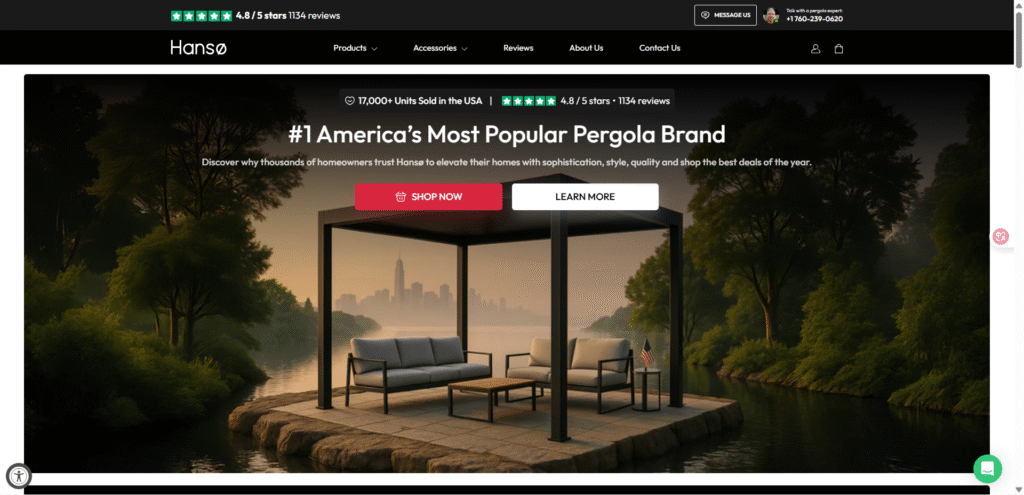
In the US outdoor living market, Hanso Home has established itself as a benchmark for D2C (Direct-to-Consumer) luxury.
🤔 The Multi-Thousand Dollar Question
With a Hanso pergola price range of $5,000 to $15,000+, consumers are often left asking: Is the Hanso pergola worth the money?
The question isn’t just about affordability; it’s about value engineering. Are you paying for Aerospace-Grade materials and heavy-duty engineering, or are you absorbing the high Customer Acquisition Costs (CAC) inherent in modern D2C branding?
To answer “why are premium aluminum pergolas so expensive,” we must look beyond the marketing copy and inspect the material science, structural load calculations (ASCE 7-10/7-16), and supply chain economics that drive the real cost of a motorized pergola.
📜 The History of Hanso Pergola & The D2C Shift
How Did Hanso Pergola Grow and Gain Widespread Recognition?
Hanso identified a gap between “Big Box” retail kits (often using non-structural vinyl or thin-gauge steel) and custom fabrication. By leveraging a digital-first strategy, they standardized the motorized louvered pergola into a modular product.
🚀 Triumph of Brand Positioning
Their success isn’t just luck; it’s a triumph of Brand Positioning. By focusing on Hanso Home social media marketing and influencer validation, they built trust in a high-ticket item online.
💡 The D2C Reality Check
However, in the direct to consumer pergola brands vs manufacturers dynamic, “D2C” often implies “cutting out the middleman.” In reality, for many brands, the “brand itself” becomes the new middleman, replacing the retailer margin with marketing and logistics overheads.
💰 Why Are Hanso Pergolas So Expensive: 8 Reasons (Technical & Economic Breakdown)
Here is a breakdown of the cost drivers, referenced against industrial standards.
Reason 1 – Premium Materials: The Reality of “Aerospace Grade”
Hanso advertises 6063-T5 aluminum.
🧪 Engineering Fact Check:
- Material: 6063 is an architectural alloy known for excellent extrudability and surface finish.
- Temper (T5): T5 indicates the aluminum is cooled from an elevated temperature and artificially aged.
- Standard Reference: According to ASTM B221, 6063-T5 has a minimum tensile strength of approx. 186 MPa (27,000 psi).
Is 6063 T5 aluminum worth the premium? Yes, compared to steel (prone to oxidation) or vinyl. However, this is the industry standard for any quality pergola, not a unique feature. The cost driver here is the weight per meter.
- Budget Pergolas: Wall thickness <1.5mm.
- Premium Pergolas (Hanso/ProGolas): Wall thickness 2.0mm – 3.0mm in load-bearing columns. The price difference is directly correlated to the global LME (London Metal Exchange) aluminum index.
Reason 2 – Engineering for Wind & Snow (ASCE 7 Standards)
High costs come from meeting ASCE 7 (Minimum Design Loads for Buildings and Other Structures) standards. Hanso pergola wind rating and snow load claims (often 100-120mph) require:
- Finite Element Analysis (FEA): Computer simulations to ensure the structure doesn’t undergo plastic deformation under load.
- Internal Reinforcement: The cost isn’t just the outside profile; it’s the internal “I-beam” or “X-beam” ribs hidden inside the posts.
Cost Factor: Engineered structures for high snow load regions require 30-40% more raw aluminum than decorative aesthetic pergolas.
Reason 3 – Integrated Systems & IP Certification (UL Standards)
A motorized louvered pergola with LED lights and heater is an electrical appliance.
⚡ Safety Standards:
- Motors: Reliable linear actuators must meet UL 1004 (Electric Motors) or UL 325 standards to be legally installed and insured in many US municipalities.
- Waterproofing: Electronics must be rated IP65 or IP67 (Ingress Protection) to survive rain and dust.
Integrating these certified components and designing modular aluminum pergolas with integrated drainage (internal guttering) increases tooling and assembly costs significantly compared to manual systems.
Reason 4 – Scandinavian Aesthetics & Tolerance Control
Scandinavian style aluminum pergola design implies hidden joinery.
Manufacturing Cost: To hide screws and bolts, manufacturers must use tighter tolerances (referencing ISO 2768-m standards for machining). Molds must be precise to ensure water-tight seals without visible caulking. This aesthetic minimalism requires more expensive CNC machining time.
Reason 5 – The “Brand Tax”: Marketing & CAC
This is the intangible cost driver. How marketing affects pergola prices:
In the e-commerce luxury goods sector, the Customer Acquisition Cost (CAC)—the money spent on ads to get one person to buy—can range from 15% to 25% of the product price.
- Influencer Marketing: Sending a free $8,000 pergola to a YouTuber is a marketing expense that is amortized across all product sales.
- Brand Positioning: You are paying for the trust, the glossy website, and the curated “Hanso” lifestyle image.
Reason 6 – Logistics & “Last Mile” Costs
US warehouse pergola shipping costs are at historic highs.
- Freight Index: Shipping a 600lb crate via LTL (Less-Than-Truckload) carrier with a lift-gate service can cost $500-$1,000 per unit.
- Warehousing: Storing inventory in US fulfillment centers incurs storage fees. Local stock aluminum pergola vs made to order: Hanso’s ability to ship quickly means they are paying for inventory holding costs, which is reflected in the premium price.
Reason 7 – Warranty Liability & Support Infrastructure
Hanso pergola warranty (often 10 years on structure) is a financial liability on their balance sheet.
- Risk Premium: A portion of every sale is set aside to cover future warranty claims (motor failures, shipping damage).
- Support Staff: Maintaining a US-based support team adds significant OPEX (Operating Expense) compared to a factory that simply ships F.O.B. (Free On Board).
Reason 8 – Long-Term Value & Home Valuation
📈 Aluminum pergola vs vinyl pergola lifespan:
- Vinyl: 5-7 years (prone to UV embrittlement).
- Aluminum (AAMA 2603/2604 coated): 20+ years.
Real estate data suggests that permanent, high-quality outdoor structures contribute to property value (Recovered Cost Value), whereas temporary structures do not.
⚖️ Conclusion: The Verdict on Value
So, is the Hanso pergola worth the money?
The answer depends entirely on what you value most as a homeowner.
The “Convenience” Buyer
If you value a polished purchasing experience, excellent customer service, US-based stock availability, and the social proof of a recognized brand, then Hanso is a solid investment. You are paying a premium, but you are buying certainty and a curated lifestyle product that is engineered well above “big box” store standards.
The “Value-Engineering” Buyer
If your priority is maximizing the price-to-performance ratio, the math suggests you might be overpaying for marketing. The reality of the supply chain is that the “Aerospace Grade” aluminum and “Heavy-Duty” engineering marketed by premium D2C brands can often be found through factory-direct suppliers or specialized contractors for 30-40% less.
How to spend your pergola budget wisely:
Ultimately, do not judge a pergola by its Instagram ads. Judge it by its spec sheet.
Before you swipe your card for $10,000, ask for the technical data:
- Aluminum Alloy: Is it 6063-T5 or T6?
- Profile Thickness: Is the main beam at least 2.0mm-3.0mm thick?
- Certifications: Are the motors UL-listed? Is the coating AAMA 2604/2605 rated?
By focusing on these engineering metrics rather than the logo, you ensure your investment stands the test of time—regardless of the name on the box.