

☀️ Introduction: Do Pergolas Actually Provide Shade?
It is the single most common question I hear from homeowners, architects, and even new distributors visiting our factory showroom: “Do pergolas actually provide shade?”
The confusion is understandable. Historically, a “pergola” was defined as an open framework designed to support climbing plants, offering little more than decorative shadows. But today, the definition has evolved. In the aluminum manufacturing world, we are no longer just building frames; we are engineering light management systems.
The short answer is: Yes, absolutely. But the quality and quantity of that shade depend entirely on the engineering behind the roof.
👷♂️ The Engineer’s Perspective
In this comprehensive guide, I’m going to take off my sales hat and put on my engineer’s helmet. I will walk you through exactly how shade works under different pergola structures, backed by the physics of sun angles and my 20 years of experience on the production line. Whether you want dappled morning light or a complete shield against the midday sun, you’ll learn how to configure the perfect setup.
🌥️ Do pergolas provide shade?
1. Quick Answer: How much shade can you expect?
The shade a pergola provides is not a fixed number; it is a spectrum ranging from decorative shadow lines to complete UV blocks.
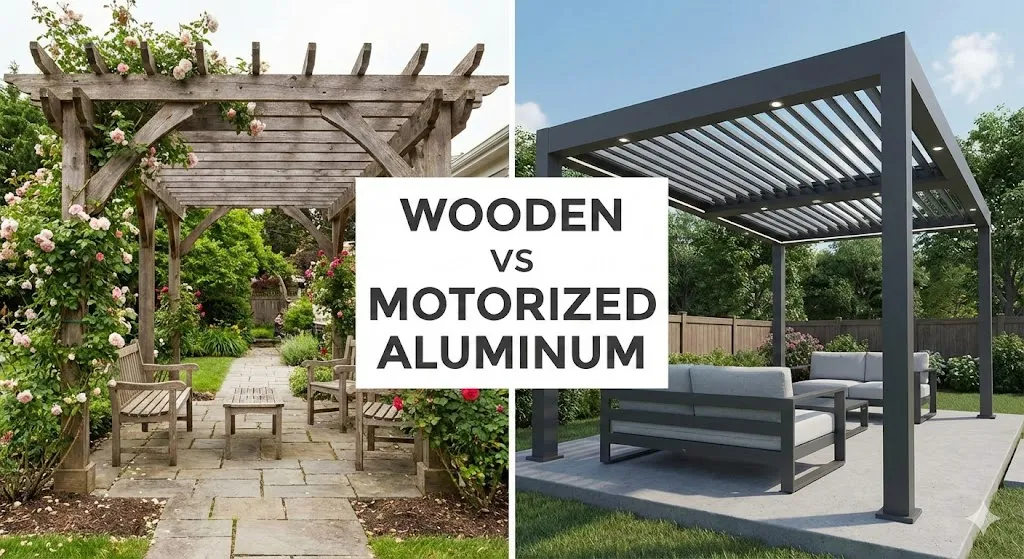
At noon, with widely spaced rafters, you might get 20% to 30% shade. You are mostly exposed.
Like the units we manufacture at ProGolas—with louvers closed, you get 100% shade.
2. The Short Truth: Filtered Shade vs. Darkness
Unless you opt for a solid insulated roof panel, most pergolas are designed to provide filtered shade. This is a feature, not a bug. Full darkness is for caves; outdoor living is about comfort.
The goal is to reduce the Mean Radiant Temperature (MRT)—how hot it feels to your body—without making the space feel gloomy. By filtering the light, we cut the glare and heat but allow ambient brightness to remain.
3. When can a pergola provide full shade?
There is a specific configuration where a pergola mimics a solid roof: Bioclimatic Louvered Pergolas. When the aluminum blades are rotated to a fully flat, interlocked position, they create an opaque barrier.
In this state, the pergola blocks direct solar radiation entirely, creating a sharp shadow line. This is crucial for high-summer afternoons when the UV index is at its peak.
[Internal Link: What is a pergola? Read our definition here]
📐 What determines how much shade a pergola provides?
This is where the engineering comes in. Shade isn’t magic; it’s geometry. Here are the factors that dictate your comfort level.
1. Roof Type (The Biggest Factor)
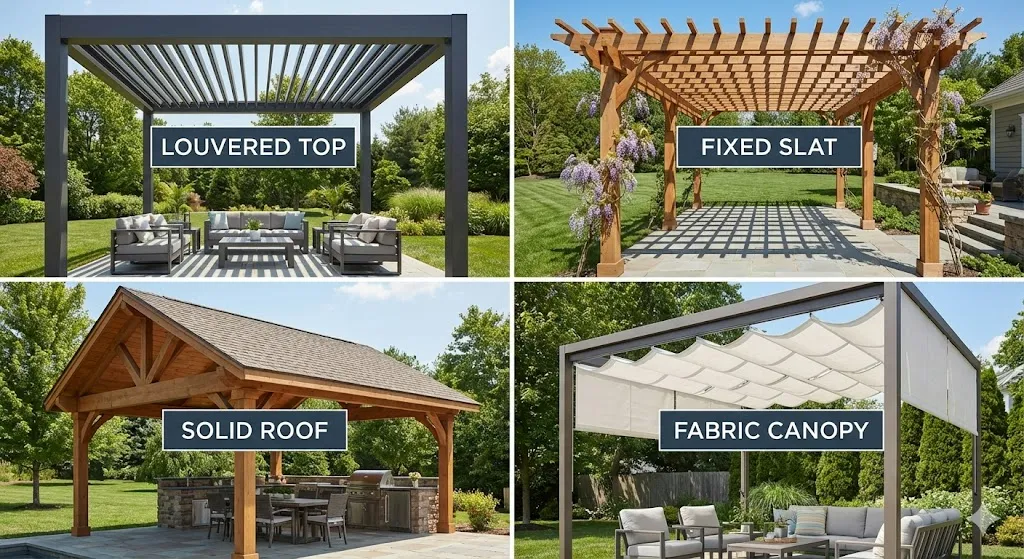
An adjustable louvered roof gives you control. You can have 0% shade (open for winter sun), 50% shade (angled to block sun but let in air), or 100% shade (closed).
Angled permanently (usually 45°). Great for maintenance but lacks flexibility. If the sun is lower than the angle of the slat, light streams right through.
Essentially patio covers using sandwich panels. Best heat insulation but offers no airflow through the roof.
Creates diffused shade. Note that openness matters: A 5% “openness factor” blocks 95% of UV, while a loose weave might only block 50%.
2. Slat Angle, Spacing & Orientation
“I remember a custom order back in 2018 for a resort in the Maldives. The architect insisted on an ultra-wide spacing of 150mm between fixed blades for an ‘airy aesthetic.’ I warned them that at their latitude near the equator, the midday sun is almost vertical. With 150mm spacing, the sun would shoot straight through the gaps between 11 AM and 1 PM.”
The Fix: We re-engineered the mold to add a “wing” tip to the blades, widening the shadow profile without changing the visual spacing. Lesson: Spacing must be calculated based on the sun’s angle of incidence, not just aesthetics.
- 🧭 Fixed Slat Direction: North/South blades give consistent changing light. East/West blades can be dangerous—early morning sun might shine parallel to the blades, bypassing shade entirely.
- 📐 Louver Tilt: For motorized pergolas, the “best angle” in summer is usually tilted slightly away from the sun to block the beam while reflecting light in.
3. Location + Sun Path + Size
- Larger Span: A 10×10 shadow only exists at noon. At 4 PM, the shadow shifts. Larger pergolas keep the table shaded longer.
- Higher Roof: Higher ceilings allow more “ambient light” to bounce in. 10ft feels brighter than 8ft due to diffusion.
The sun’s position changes drastically depending on latitude. A pergola in New York (40° N) requires different louver calibration than one in Miami (25° N) because “solar noon” height differs. This is why “one-size-fits-all” fixed pergolas often fail in specific regions.
4. Side Screening (For Low Sun)
If you have a West Exposure (the “enemy” of outdoor dining), a roof isn’t enough.
- 🔽 Drop-down Zip Screens: Can block 90-95% of UV rays while retaining the view.
- 🧱 Fixed Slatted Walls: Create permanent “privacy corners.”
- 💨 Curtains: Flexible shade, though they flap in the wind compared to track-retained zip screens.
🌳 How much shade does a pergola provide in real life?
Let’s move from theory to reality. Here is what you can expect in different scenarios.
1. Typical Shade Ranges
- ☀️ Open Slats: Light shade (“dappled light”). Breaks heat but you need sunglasses.
- ⛅ Fixed Slats: Medium shade (40-60%). Good for plants, maybe not for laptops.
- ☁️ Adjustable Louvers: Medium → High (5% to 100%). Ultimate versatility.
- ☂️ Solid Roof: Full shade + Rain cover. Significantly darker underneath.
2. The Shade “Footprint” & Drift
The shadow is rarely directly underneath.
- Noon: Shadow is under the roof.
- 5 PM: Shadow is 10 feet to the East.
🍹 “Happy Hour” Tip: If building for evening cocktails, position the structure West of where you plan to sit.
To account for “shadow drift,” we recommend sizing up. If your table is 10ft wide, a 12ft pergola might leave end chairs in the sun. A 14ft or 16ft span solves this.
🎯 Best Pergola Options for Different Shade Goals
🍽️ For Dining Areas (Reduce Glare + Heat)
You need to block the overhead sun to keep the butter from melting, but you also want to open the roof at night to see the stars while eating.
🛋️ For Lounges/Sofas (Comfortable, Cooler)
For lounging, you want maximum thermal comfort. Insulated panels stop the heat from radiating down.
🏊 For Poolside (UV + Glare Control)
Glare off the water is intense. Adjustable louvers allow you to block the reflection while keeping the “open air” feel.
🌿 For Plants/Garden (Dappled Light)
Plants need photosynthesis. A solid roof will kill them. Fixed slats provide the perfect balance of light and protection.
🏭 Industry Case Study: Sunset Hill, California
We recently supplied a project for the “Sunset Hill” residential complex. The challenge was a communal BBQ area that faced directly West. The residents complained it was unusable after 4 PM due to blinding sun.
We installed a series of ProGolas PrimeEdge units equipped with automated louvers AND motorized zip screens on the West face.
The screens cut the low-angle glare by 95%, while the louvers remained slightly open to vent the BBQ smoke. The area went from being empty in the evenings to the most popular spot in the complex. This proves that vertical shade is just as important as horizontal shade.
🛠️ How to get more shade from a pergola (practical upgrades)
If you already have a pergola or are designing one, here is how to maximize the shade factor.
1. Choose tighter slat spacing or add battens
📏If building custom, reduce the gap. Moving from 6-inch spacing to 3-inch spacing doubles your shade without losing airflow.
2. Add a retractable canopy or shade cloth
⛺This is the easiest retrofit. Running a wire-hung canopy under the rafters gives you convertible shade.
3. Add side screens for low-angle sun
🌅As mentioned in the case study, the sun moves. Screens chase the sun for you.
4. Combine pergola + outdoor curtains
🎭Curtains add a softness and can be drawn to block a specific beam of light hitting someone’s face.
5. Consider orientation when installing (Most Overlooked)
🧭Orient the slats perpendicular to the primary sun direction you want to block.
⚖️ Pergola vs patio cover: which provides more shade?
| Feature | Patio Cover (Solid) | Traditional Pergola (Open) | Louvered Pergola (Hybrid) |
|---|---|---|---|
| Direct Shade | 100% Constant | 20-40% Constant | 0-100% Adjustable |
| Glare Control | High | Low | High (when angled) |
| Heat Build-up | Can trap heat | Low (vents heat) | Low (vents heat) |
| UV Protection | 100% | Low | 100% (when closed) |
H3: Trade-offs: airflow, heat, rain protection, budget
A solid patio cover provides the most shade, but it can create a heat trap. A pergola provides better quality shade because it allows hot air to rise and escape, creating a natural cooling convection current.
☀️ Does a pergola reduce heat and UV? (What shade really means)
1. Shade vs Temperature (Why Airflow Matters)
Shade does not lower the air temperature; it lowers the surface temperature. However, airflow does make you feel cooler.
🌡️ The Result: A louvered pergola angled to block the sun but allow air passage can feel 10-15 degrees cooler than standing in direct sun.
2. UV Protection Basics (The Science)
A study published in the Journal of Facade Design and Engineering analyzed the thermal performance of semi-outdoor shading systems.
The Conclusion: Adjustable shading systems (like louvers) can reduce the Solar Heat Gain Coefficient (SHGC) by up to 85% compared to exposed surfaces, significantly improving thermal comfort without requiring mechanical cooling.
This validates that the “shade” from a pergola is a quantifiable engineering metric, not just a visual one.
3. Material + Color Impact (Aluminum vs Wood)
According to recent industry data from the Outdoor Living Association:
- ⚪ White/Light Aluminum: Reflects approximately 70-80% of solar radiation.
- ⚫ Dark Wood/Black Aluminum: Absorbs solar radiation.
💡 Takeaway: While dark colors look modern, a white louver blade will physically radiate less heat down onto your dining table than a black one.
🚫 Common Misconceptions About Pergola Shade
1. All pergolas provide full shade — False
❌ The Reality: Do not buy a pergola assuming it is a roof. Unless it is louvered or fabric-covered, it is a filter, not a solid barrier.
2. Louvers block all sun at any time — Depends on Sun Angle
⚠️ The Reality: Even with louvers, if the sun is at the horizon (sunrise/sunset), light can sneak between the blades.
💡 The Fix: This is why side screens are essential for complete coverage.
3. Bigger pergola always means better shade — Not Always
📐 The Reality: A huge pergola with the wrong orientation will still be uncomfortable. Design beats size.
🚀 Get a Shade Plan in 24 Hours
Are you a contractor or distributor trying to configure the perfect shade solution for a client?
Don’t guess—let us engineer it.
📋 What We Need From You:
- 📍 City/Location: (for sun angle calculation)
- 🧭 Orientation: (North / South / East / West)
- 📏 Size: (Rough size requirements)
- 🎯 Primary Goal: (Dining? Poolside? Garden?)
- 📷 Site Photos: (Upload via email or form)
✅ Our Deliverable: The Shade-First Spec Sheet
We will generate a specification sheet for you, recommending the exact louver orientation and necessary screen add-ons to guarantee your client gets the comfort they expect.
Contact ProGolas today to start your project.
❓ FAQ: Pergola Shade Capabilities
Q1: Can a pergola provide shade in the afternoon?
Yes, but the effectiveness depends on the design. An overhead roof is great for noon sun. For late afternoon (4 PM – 7 PM), the sun is lower in the sky.
☀️ The Solution: To get shade in the afternoon, you almost certainly need vertical shading like zip screens, curtains, or a slatted wall on the Western side of the pergola.
Q2: Do louvered pergolas provide shade when open?
Yes. Even when open to 45 degrees or 90 degrees, the blades themselves cast shadows. As long as the louvers aren’t perfectly parallel to the sun’s rays, they will provide a “striped” shade pattern that reduces overall glare.
Q3: How much shade does a 10×12 pergola provide?
In terms of area, it covers 120 square feet. However, due to shadow drift, the usable shade at 3 PM might only be 80 square feet, shifted slightly to the East. Always plan for the shadow to move.
Q4: What’s the best pergola roof for maximum shade?
For maximum flexibility and shade density, a motorized louvered roof is superior. It allows you to block 100% of the sun like a solid roof when needed, but also lets you angle the light for “indirect lighting” so the space doesn’t feel like a cave.
Q5: Do pergolas provide shade and rain protection?
- ❌ Traditional: Open-rafter pergolas do not stop rain.
- 💧 Modern: Aluminum louvered pergolas (bioclimatic) are designed with interlocking blades and internal gutters. When closed, they are waterproof and provide 100% rain protection along with the shade.
Q6: Is a pergola worth it if I want full shade?
If you want permanent, unchangeable full shade, a solid patio cover is cheaper.
But if you want the option of full shade combined with the ability to enjoy the winter sun or see the stars, a pergola is absolutely worth the investment. It offers a dynamic living space rather than a static one.