

🏗️ Introduction: More Than Just Fabric on a Wall
1. The Reality from the Factory Floor
In my 20 years on the manufacturing floor, overseeing the extrusion of aluminum profiles and the stitching of industrial textiles, I have seen thousands of outdoor shading systems leave our loading docks.
“Yet, I still see homeowners and even some contractors confuse the terminology. They ask for a ‘canopy’ when they mean a ‘retractable awning,’ or they buy a ‘pergola’ when a window awning would have solved their heat gain problem for a tenth of the price.”
2. It Is a Dynamic Architectural Feature
An awning is not just a piece of fabric stuck to a wall. It is a system that balances tension physics, material science, and weather resistance.
- ✅ Engineered Correctly: It can reduce indoor cooling costs by 25% and expand your living space.
- ❌ Engineered Poorly: It becomes a giant sail waiting to rip your siding off during the first summer storm.
3. Behind the Scenes
In this guide, I am going to take you behind the scenes. We will move past the basic definitions and look at the molecular structure of fabrics, the tension mechanics of the arms, and the installation protocols that separate a DIY disaster from a commercial-grade solution.
🏠 What is an awning?
1. Quick Definition

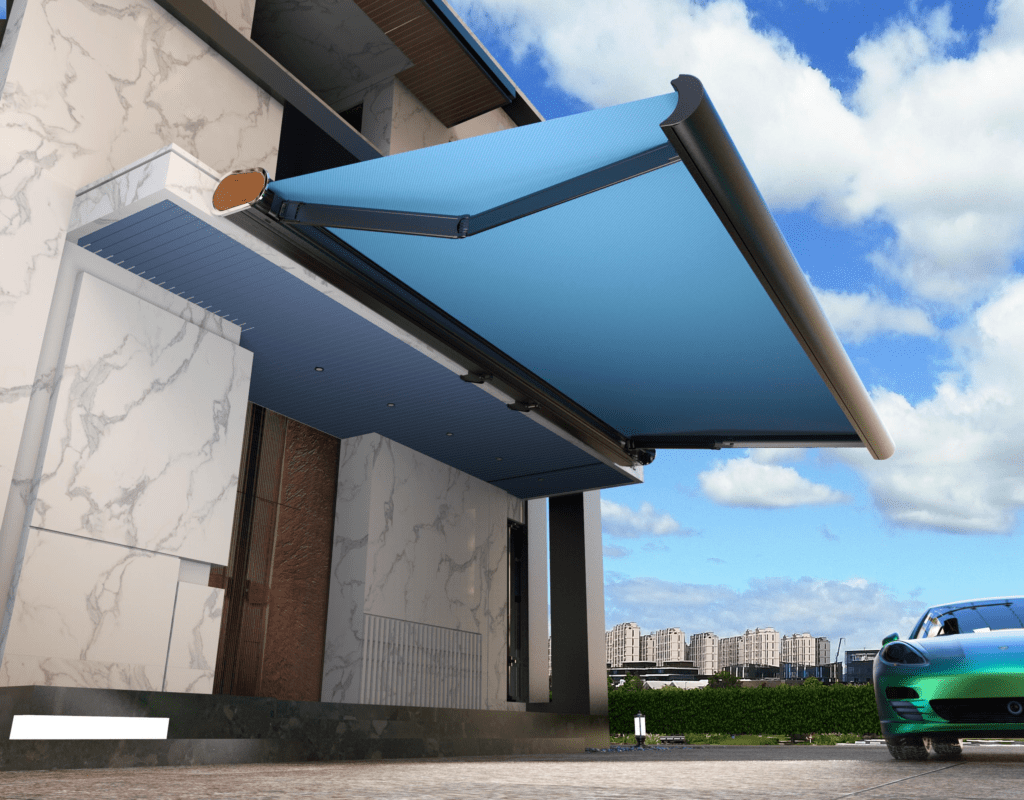
An awning is a supplemental roof or cover, typically composed of a fabric or metal sheet, that extends from the exterior wall of a building to provide protection from the sun and rain. Unlike a permanent roof, it is a secondary appendage designed specifically for weather control.
2. What an awning does (Shade, Rain, Comfort)
At its core, an awning serves three functional purposes:
- ☀️ Solar Heat Gain Control: It stops solar radiation before it hits the glass of your windows or the masonry of your patio. This is significantly more effective than internal blinds.
- 🌧️ Hydrostatic Protection: It acts as a shield against rain, directing water away from doorways, windows, and foundations via a pitched angle.
- 🏡 Spatial Extension: It creates a “transition zone” between the indoors and outdoors, effectively increasing the usable square footage of a home or restaurant without requiring a foundation or permanent walls.
3. Awning vs Canopy vs Pergola (Fast Clarification)
The key distinction lies in the structure. An awning is cantilevered (supported entirely from the wall). A canopy usually has vertical support columns (legs) at the outer edge. A pergola is a permanent structure with a horizontal grid, supported by columns, which may or may not have a roof.
- Awning: Wall-mounted, no legs, retractable.
- Canopy: Legs, usually fixed fabric.
- Pergola: Permanent structure, heavy-duty.
🧱 Awning Materials (What Buyers Actually Choose)
The lifespan of an awning is directly tied to two things: the fabric that faces the sun, and the metal that holds it up. In the factory, we see distinct differences in performance based on these choices.
🧵 Fabric Options
1. Solution-Dyed Acrylic (Fade Resistance, Long Life)
A technical study by the Industrial Fabrics Association International (IFAI) confirms that solution-dyed acrylic creates a molecular bond superior to surface dyeing. The pigment is added to the liquid polymer before extrusion.
🥕 Imagine a carrot (orange all the way through) versus a radish (red skin, white inside).
- ✅ Pros: Breathable (allows hot air to escape), 10-year fade resistance, mold resistant (if treated).
- ❌ Cons: More expensive than polyester.
2. Polyester (Budget Option, Light Duty)
Polyester is strong, but standard polyester fades rapidly under UV exposure.
Many cheap online awnings use “PU Coated Polyester.” It looks great out of the box, but within two years, the UV radiation breaks down the coating, the fabric becomes brittle, and the color turns into a washed-out grey.
Use Case: Only acceptable for temporary setups or RV camping awnings that are rarely deployed.
3. PVC-Coated Fabric / Vinyl (Rain-Heavy, Easy Clean)
This is a polyester mesh sandwiched between layers of liquid PVC (Polyvinyl Chloride).
- ✅ Pros: 100% waterproof. You can pressure wash it.
- ❌ Cons: It traps heat. Standing under it can feel like standing in an oven because hot air cannot rise through the material.
Use Case: Commercial storefronts and restaurants where rain protection is more important than airflow.
🏗️ Frame Options
1. Aluminum (Corrosion Resistance, Most Common)
95% of the awnings we manufacture utilize 6063-T5 aluminum extrusions. Aluminum naturally forms a protective oxide layer that prevents rust.
Note: The wall thickness determines if the arm bends under wind. We powder coat these to AAMA 2603/2604 standards to prevent chalking.
2. Steel (High Strength, Needs Anti-Rust Treatment)
Steel is heavy and strong (used for torsion bars). However, steel rusts. If you buy a steel-framed awning for a coastal home, it must be hot-dip galvanized or stainless steel, otherwise, salt air will destroy mounting points within 3 years.
3. Mounting Hardware Basics (Anchors/Brackets Matter)
The hardware is the unsung hero. We use stainless steel bolts.
Why? Galvanized bolts react with aluminum (galvanic corrosion), eventually welding themselves together so you can never disassemble the awning for repair.
⚙️ How does an awning work? (Simple Mechanism Overview)
An awning is a kinetic machine. It fights gravity and wind simultaneously.
1. The “5 Main Parts” You Can Point to On-Site
- 🔩 Mounting Brackets / Wall Plates:These distribute the sheer force and torque load into the structural studs or masonry of the building.
- 🌯 Roller Tube + Fabric:A galvanized steel tube (usually 70mm or 80mm diameter) that holds the fabric.
- 💪 Arms (Articulated / Tension System):🏭 Factory Experience Story:
On our assembly line, the most dangerous station is the “Arm Pre-Tensioning.” The folding arms are loaded with powerful internal springs or pneumatic pistons. I once watched a new technician accidentally release the safety pin on an arm before it was secured. The arm snapped open with enough force to break a 2×4 piece of lumber.
⚠️ Warning: Never attempt to disassemble an awning arm yourself—the stored kinetic energy is dangerous.
- 📏 Front Bar (Keeps Fabric Taut):The aluminum profile at the very front. It connects the arms and the fabric.
- 🎮 Manual Crank or Motor (Optional):The gearbox spins the roller tube. As the tube spins, the arms push out (extension) or are pulled in (retraction).
2. How Projection + Pitch Angle Control Shade & Rain
Water weighs 8.34 lbs per gallon. If your awning is flat, water pools in the center. The fabric stretches, creating a “belly.” Eventually, the weight snaps the arms.
The Rule: You need a minimum pitch of 14 degrees (about 3 inches of drop for every foot of projection) to allow gravity to drain the water.
Besides pooling, a flat awning catches the wind like a sail. A steep pitch allows wind to flow over the top, reducing uplift force.
🏘️ What is an awning used for? (Real-Life Use Cases)
1. Patio/Deck Shading (Outdoor Dining, Lounge)
This is the most common use. It transforms a scorching deck into a usable room.
🌡️ The Benefit: By lowering the surface temperature of the pavers or wood deck, it reduces the heat radiating upward, making the air feel 10-15 degrees cooler.
2. Window Shading (Reduce Heat, Glare, Fading)
According to the Professional Awning Manufacturers Association (PAMA), installing an awning over a window can reduce solar heat gain by:
- Up to 77% for West-facing windows.
- Up to 65% for South-facing windows.
💡 This directly translates to energy savings, lowering air conditioning loads during peak summer months.
3. Commercial Storefront Cover (Comfort + Branding)
For businesses, an awning is signage. It provides a dry area for customers to shake off umbrellas before entering and protects window displays from UV bleaching.
4. Outdoor Seating for Restaurants/Cafes
In the post-pandemic era, outdoor seating is revenue. An awning allows restaurants to monetize their sidewalk space even during light rain or intense noon sun.
🌤️ How much shade and rain protection does an awning provide?
1. Shade Depends on Width + Projection + Sun Angle
Shade moves. A 10-foot projection awning might cover your table at noon, but at 5 PM, the low sun angle might shoot right under it.
📏 Rule of Thumb: For Western exposures (afternoon sun), you need a longer projection or a drop valance (a fabric screen that rolls down from the front bar) to block the low sun.
2. Rain Protection Depends on Fabric + Pitch
- Acrylic: “Water resistant,” not “waterproof.” Repels water, but may mist through in a torrential downpour.
- Vinyl: 100% Waterproof.
Protection is mostly about pitch. If the pitch is steep (45 degrees), water runs off instantly, keeping the area dry. If it’s shallow, water lingers and drips through the weave.
3. Wind Limits (When to Retract)
An awning is essentially a kite anchored to your house. Most residential retractable awnings are rated for Class 1 or Class 2 wind resistance (approx. 20-25 mph). They are not designed for storms.
🌬️ Pro Tip: If it’s too windy to read a newspaper comfortably outside, retract the awning.
✅ How to choose an awning (Buyer Checklist)
Don’t just guess. Follow this checklist to ensure you order the right spec.
Step 1 — Measure the Space
- 🖍️ Mark the “coverage rectangle”: Use painter’s tape to outline where you want the shade to be on your patio floor.
- ↔️ Measure width: Measure the wall space. Ensure there are no downspouts, light fixtures, or vents in the way.
- 📏 Decide projection: Standard projections are 8′, 10′, 12′, and 13′. Note: You lose about 6-12 inches of coverage due to pitch. If you need 10′ of clear shade, buy an 11′ or 12′ projection.
For every 1 foot of projection, expect a 3-inch drop. If you mount too low, the front bar will hit your head.
Drop (10′ proj): -30″
———————–
Headroom: 66″ (5.5 ft) — Too Low! Mount it higher.
Step 2 — Choose Your Goal
Specs: More projection, breathable fabric (Solution-Dyed Acrylic), lighter pitch.
Specs: Steeper pitch, water-resistant fabric (Vinyl/Coated), mount higher for slope.
Step 3 — Choose Operation Type
- 💪 Manual Crank: Best for small awnings (under 12 ft). No electricity needed. Good for cabins.
- ⚡ Motorized: If it’s hard to use, you won’t use it. Motorization makes it a one-touch luxury.
- 🌬️ Sensors: A wind sensor (anemometer) detects vibration and auto-retracts the awning to save your investment.
Step 4 — Pick Fabric & Color
- ⚪ Light Colors: Reflect heat, hide fading better, show dirt more.
- ⚫ Dark Colors: Absorb heat (radiate warmth downward), hide dirt better, show fading sooner.
- 🍄 Mold Note: If you live in Florida or the PNW, avoid cotton blends. Stick to 100% acrylic or vinyl.
Step 5 — Check Mounting Surface Strength
The pull-out force on a fully extended awning bracket can be hundreds of pounds.
If mounting to vinyl siding, you must use a header board (a piece of lumber bolted to the studs) to bridge the gap and provide a solid surface. Never mount directly to vinyl or stucco without hitting a stud.
⚖️ Awning vs pergola vs patio cover (what’s the difference?)
| Feature | Retractable Awning | Aluminum Pergola | Permanent Patio Cover |
|---|---|---|---|
| Shade | Adjustable | Adjustable (if louvered) | Fixed (100%) |
| Rain | Light/Moderate | Heavy (if waterproof) | Heavy |
| Wind Rating | Low (20-25 mph) | High (120+ mph) | High |
| Flexibility | Disappears when closed | Permanent Structure | Permanent Structure |
| Cost | $$ | $$$$ | $$$ |
✅ When an awning is the best choice
- ✔ Limited Budget: You need a cost-effective shade solution.
- ✔ Winter Sun: You want full sun in the winter (just retract it).
- ✔ HOA Restrictions: You have strict rules against permanent structures with legs.
🏗️ When pergola/patio cover is better
- ✔ High Winds: You live in a high-wind area.
- ✔ Accessories: You want to mount fans, heavy lights, or TVs outside.
- ✔ Aesthetics: You want a defined “outdoor room” architectural feel.
🛠️ Installation Basics (What to Expect)
1. What Installers Check Before Drilling
Installers look for “cripple studs” above windows and the header beam. They tap the wall to check for hollow stucco vs solid wood.
The brackets must be perfectly level.
⚠️ Warning: If one bracket is 1/4 inch lower, the awning will roll up crooked, causing the fabric to wrinkle and the motor to burn out.
2. Typical Install Workflow (Simple 5-Step)
- Mark: Snap a chalk line on the wall.
- Prep: Drill pilot holes and inject silicone (to prevent leaks).
- Bracket Fix: Lag bolt the brackets into studs.
- Assemble: Lift the awning into the brackets (requires 2-3 people).
- Set & Test: Adjust the pitch using the adjustment bolts on the arm shoulders, then test extend/retract.
🧹 Maintenance 101
Cleaning Schedule & Do/Don’t List
- ✅ DO: Hose it off once a month with clear water.
- ❌ DON’T: Use a pressure washer on acrylic fabric (it strips the water-repellent coating).
- ✅ DO: Brush off leaves before rolling it up (leaves stain).
❄️ Retract in High Wind + Seasonal Storage
In winter, if you don’t use it, wrap the valance (the hanging fabric bit) or remove it. That little strip of fabric stays exposed all winter and often rots first.
⚠️ Common Problems and How to Avoid Them
1. Water Pooling (Too Flat Pitch / Fabric Tension)
This happens when water cannot drain fast enough, causing the fabric to belly.
- Increase the pitch angle immediately.
- Emergency trick: Push up on the fabric from underneath with a broom (gently!) to dump the water.
2. Fabric Sagging or Wrinkles (Improper Tension)
This usually means the arms aren’t pushing out hard enough, or the fabric wasn’t centered on the roller tube.
🔧 Fix: Fully extend the awning and inspect the roller tube to ensure even wrapping.
3. Fading and Mildew (Wrong Fabric for Climate)
- 🛡️ Prevention: Buying quality solution-dyed acrylic prevents fading.
- 🧼 Cleaning: If mildew forms, it’s usually on dirt sitting on the fabric, not the fabric itself. Clean the dirt.
4. Wind Damage (No Sensor / Weak Mounting)
We supplied awnings to a chain of restaurants in Chicago. The owner initially opted out of wind sensors to save $150 per unit.
“Within three months, a sudden squall line bent the arms on 4 of their 10 units, costing $4,000 in repairs.”
The Outcome: We retrofitted the remaining units with vibration sensors. Since then, they haven’t lost a single awning.
💡 Lesson: The sensor is cheaper than the repair.
🚀 Get a Recommended Awning Size + Spec in 24 Hours
Stop guessing about pitch angles and mounting heights. Let our factory engineers review your wall and recommend the perfect shading system.
📋 What We Need From You:
Send us a photo of your wall and your approximate dimensions. We will tell you exactly what brackets you need and which fabric will last longest in your specific micro-climate.
- 📍 Location: (for wind/sun analysis)
- 🧱 Mounting Surface: (Siding, Brick, Stucco?)
- 📏 Width/Projection: Approximate dimensions
- 🎯 Use Case: (Dining, Lounge, Storefront?)
- 📷 Photos: Site picture
📥 Download: Awning Measurement Checklist + Spec Sheet Template
❓ FAQ: Common Questions About Awnings
Q1: Are awnings waterproof?
- 💧 Vinyl Awnings: Are waterproof.
- ☔ Acrylic Awnings: Are water-repellent. They will shed water in a normal rain shower if pitched correctly.
Note: Prolonged heavy rain on acrylic may result in a fine mist or leakage.
Q2: How long do awnings last?
- 🏗️ Frame: 20+ years (if aluminum).
- 🧵 Fabric: 8-12 years (high-quality acrylic) vs 2-3 years (cheap polyester).
- ⚙️ Motor: 7-10 years.
Q3: Can awnings be used in windy areas?
Only if retracted. A retractable awning is a “fair-weather friend.”
⚠️ Recommendation: If you live on a windy cliffside, you are better off with a permanent aluminum pergola or heavy-duty structural canopy.
Q4: Do retractable awnings need electricity?
- ⚡ Motorized: Yes. You can hardwire them or use a plug-in cord. Solar-powered kits are available but less powerful.
- 💪 Manual: No. These use a hand crank and require no power.
Q5: What is the best awning material for hot climates?
Solution-Dyed Acrylic. It allows heat to escape through the weave.
❌ Avoid Vinyl: It traps heat and can make the area underneath feel suffocatingly hot in climates like Arizona or Texas.