

Retractable Awning Cleaning & Maintenance Guide
The “Service Tech” Approach: Safe, Dry, and Durable
Retractable awnings look simple—fabric rolls in, arms fold, job done. But if you clean them like a patio umbrella (too much water, too much force, wrong chemicals), you can shorten the life of the coating, stitching, and hardware fast.
🛠️ How We Teach New Installers
This guide is written the way we teach new installers and service techs: start dry, control water, dry completely, then lubricate only what truly needs it—so you can clean retractable awnings safely without turning one weekend job into a costly repair.
Prerequisite Reading
If you’re brand new to shade products, start with our internal primer on
what is an awning?.
(It helps you understand why cassette, roller tube, arms, and pitch angle matter for cleaning).
Part 1: Clean Smarter Before You Clean Hard
Introduction: Why “Gentle + Systematic” Wins
Most homeowners search how to clean retractable awnings after one of three moments: pollen season, a rainy week, or the first tiny black dots that trigger the fear of mildew. The “best way to clean a retractable awning” is rarely a stronger chemical—it’s the right order of operations and the discipline to stop water from getting trapped where it can’t dry.
👥 Who this guide is for (Home / Commercial / Storefront)
This is practical whether you’re:
- A homeowner looking for retractable awning care tips for homeowners and a low-hassle routine.
- A café/restaurant manager needing retractable awning maintenance tips for commercial patios where staff open/close the shade constantly.
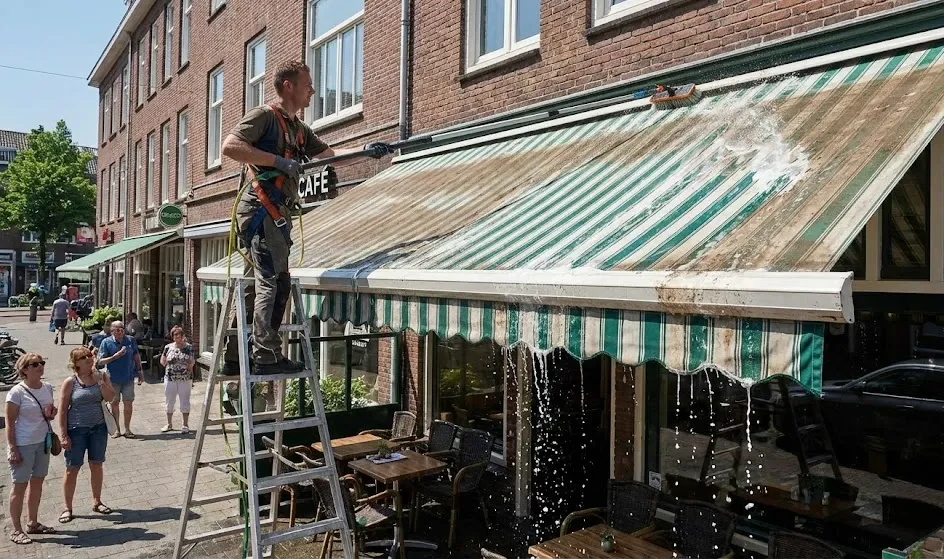
- A shop owner with signage and a front entrance canopy trying to clean patio retractable awnings without splashing windows, walls, or inventory.
No matter your use case, you’ll get the same core outcome: how to extend awning lifespan (retractable) by preventing coating damage, corrosion, and hidden moisture.
The 4 Principles That Prevent 90% of Damage
These are the four rules we repeat during service calls and they map directly to retractable awning do’s and don’ts:
A retractable awning is not a shower curtain. Water that runs into hems, seams, and the roller area can stay there. Less water = faster drying = fewer mold cycles.
Dry grit is what turns a sponge into sandpaper. Dry brushing first is the foundation of clean retractable awning without removing fabric (you’re removing the abrasive layer before you introduce moisture).
Rolling up damp fabric is the #1 cause of odor and spots—especially in humid climates. This is also the biggest driver behind how to prevent retractable awning mold and mildew.
Over-lubrication attracts dust, turns to grime, and can cause new noise. A good retractable awning lubrication guide looks boring: tiny amounts, applied precisely, wiped clean.
🔄 One Sequence You Can Memorize
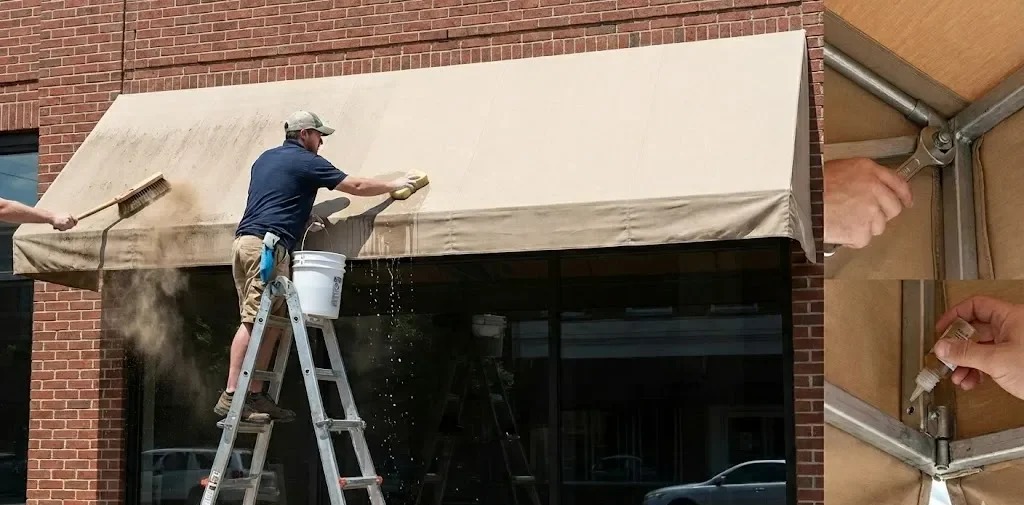
When people ask for retractable awning cleaning steps (step by step), here’s the “one-line” workflow:
If you remember only one thing for Maintain Retractable Awnings, make it that order.
Quick Self-Check Checklist
1 minute fabric / 3 minutes structure / 5 minutes test run
This mini retractable awning inspection before use routine takes 1–5 minutes and saves you from cleaning a unit that’s unsafe, misaligned, or already failing.
How to Interpret Results (Clean / Maintain / Stop & Service)
Use this quick matrix for when to stop using a retractable awning:
| Self-check result | What it likely means | What to do next |
|---|---|---|
| Fabric dusty, structure solid, smooth test run | Normal seasonal buildup | Proceed with how to clean retractable awning fabric step by step |
| Light squeak + visible grit in joints | Needs cleaning + targeted lubrication | Clean first, then follow retractable awning lubrication guide |
| Bracket movement, wall cracks, arm bend, harsh jerking | Safety/structural risk | Stop use; schedule service (don’t “clean through” it) |
| Mold odor + black spotting after rain | Moisture trapped / wet retraction history | Follow how to clean an awning with mold and change drying habits |
Part 2: Tools + The Core Cleaning Process You Can Repeat
Tools You’ll Need (cleaning, inspection, lubrication, safety)
People often ask “what’s the best cleaner for retractable awning fabric?” The honest answer: the best cleaner is the one that removes soil without stripping coatings and that you can rinse out completely with low water.
How to Clean Retractable Awning Fabric
Step-by-Step, Without Removing It
This is the core section for how to clean retractable awning fabric and the safest answer to clean retractable awning without removing fabric. We’ll cover manual and motorized versions, plus “after rain,” and how to clean retractable awning without pressure washer.
💡 Featured Snippet: What is the best way to clean a retractable awning?
The best way to clean a retractable awning is to dry-brush first, then wash gently with a mild soap solution using minimal water, rinse with low pressure, and let the fabric fully air-dry before retracting. After cleaning, inspect mounts and arms, tighten hardware if needed, and lubricate joints sparingly.
Step 1: Pick the right time and set the awning correctly
This is the most ignored part of best time of day to clean retractable awning (morning/evening).
- Choose conditions: Overcast, early morning, or late afternoon reduces fast evaporation and helps prevent retractable awning water stains after cleaning. Avoid windy hours: wind drives dust into wet fabric and makes ladder work unsafe.
- Extend fully: Fully extend and lock the awning so folds open up—this reduces hidden grime and improves cleaning coverage.
- Motorized safety: For how to clean a motorized retractable awning, turn off power at the switch/breaker or unplug if your system supports it. Then keep the remote away from anyone “testing buttons.”
- Protect the area: Lay a drop cloth to keep runoff from staining decking. Move outdoor cushions inside. Close doors/windows under the awning.
Step 2: Dry clean first (remove grit before you add moisture)
This is the “secret” behind retractable awning cleaning steps (step by step) that feels like real fieldwork.
- Start top-to-bottom: Use a soft brush on an extension pole. Work from the cassette/roller area toward the front bar. Brush in long strokes—don’t scrub in tight circles yet.
- Pay attention to trap zones: The front bar lip and hem are where leaves collect. Side seams and valance edges hold dust lines. If your awning has tracks or guide rails, brush those too—grit here causes noise and wear.
In factory QC, we see coating failures accelerate when grit is rubbed into wet fabric. The first micro-scratches don’t look dramatic, but they create a “dirt magnet” texture that makes the next cleaning harder. Dry brushing prevents that compounding damage and supports how to clean retractable awning fabric without damaging coating.
Step 3: Mix a gentle cleaner (light on chemistry, heavy on rinsing)
People ask for best cleaner for retractable awning fabric because they want a single miracle bottle. In practice, you want a safe baseline mix and a clear escalation path.
- Safe baseline mix: Bucket of lukewarm water + a small amount of mild soap (start “weaker than you think”). For most dirt, less is more—high soap concentration is a common cause of residue and water rings.
- Manufacturer-aligned guidance: Sunbrella publishes care guidance for shade fabrics including a bleach + mild soap dilution option for mold/mildew stains. Always confirm your fabric type and test a small area before using stronger solutions.
Quick dilution table (practical starting points)
(Adjust based on fabric manufacturer instructions and always spot test.)
| Soil level | Cleaner strength | Where to use | Notes |
|---|---|---|---|
| Dust / pollen | Very mild soap solution | Whole canopy | Most jobs end here |
| Drip lines / light grime | Mild soap solution + longer dwell | Edges, front bar line | Use sponge press + lift |
| Musty smell / small black dots | Fabric-safe mildew remover OR manufacturer-recommended dilution | Spot zones only | Test first; rinse longer |
Step 4: Wash the fabric gently (press + lift, don’t grind)
This is the heart of how to clean retractable awning fabric step by step and the most important part of best way to clean a retractable awning.
- Technique that matches real field results: Dip sponge or microfiber cloth in your solution. Press onto the fabric to wet the fibers. Use small circles with light pressure (think “polishing,” not “scrubbing a grill”). For stubborn spots, let the solution dwell 3–5 minutes, then repeat.
- Avoid hard brushes: Hard bristles can raise the nap or abrade coatings—especially on polyester with PU-type finishes.
- Control water: Use a spray bottle or a low-flow garden hose. The goal is “enough water to rinse soap,” not “enough water to soak the roller.” This is exactly how to do how to clean retractable awning fabric without removing it in a way that prevents hidden moisture.
Step 5: Rinse properly (low pressure, more time)
If you want to know how to rinse awning fabric properly, it’s this: Keep the water flow gentle. Rinse from top to bottom. Rinse longer than you think you need.
- No pressure washer: If you’re searching should you use a pressure washer on awning fabric or how to clean retractable awning without pressure washer, treat “pressure washing” as a last resort only with wide fan tips, long distance, and manufacturer permission. For most awnings, high pressure can damage seams and coatings.
- Why low pressure wins: High pressure can drive water into hems and stitching channels, and can create uneven “clean lines” that become retractable awning water stains after cleaning when the soap dries in place.
Step 6: Dry completely before retracting (the mold prevention step)
This step answers retractable awning drying time before retracting and is the core of how to prevent retractable awning mold and mildew.
- What “fully dry” really means: The top surface feels dry. The underside feels dry. The hem and valance edge are dry (often last). No cool dampness near seams.
- Practical drying tips: Leave the awning fully extended 4–8 hours when possible. If humidity is high, extend longer. If there’s a slight slope/pitch, water drains faster; if it’s too flat, you’ll get pooling.
For how to clean retractable awning after rain (or “what to do after a storm”), the best practice isn’t washing—it’s drying: Extend fully as soon as conditions are safe. Shake off puddles by gently tapping the front bar (don’t yank the fabric). Let it air dry fully before retracting. This one habit prevents retractable awning mold after rain (what to do) from becoming a recurring problem.
Step 7: Structure inspection (catch small issues early)
This section doubles as retractable awning maintenance checklist material.
Wall and bracket check (don’t ignore movement)
For how to tighten retractable awning brackets, do this:
- With the awning extended, visually inspect each bracket. Look for rust trails, wall cracking, or a “shadow gap” behind the plate. Check bolt heads: if they’re backing out or washers are deforming, stop.
- Tightening principle: Tighten to snug + firm, but don’t over-torque and strip anchors. If you see wall damage, don’t keep tightening—get professional support. This prevents the highest-risk failure: bracket pull-out.
Arm joints and pivots (noise and binding sources)
Inspect: Arm elbow pivots, Shoulder pivots, Any sliding interfaces. Look for: hairline cracks, deformation, metal dust (wear), audible clicking under load. If the retractable awning clicking noise when retracting is new and sharp, don’t assume “more lube” is the answer.
Front bar and roller tracking (why fabric rolls unevenly)
If retractable awning fabric rolls unevenly: The front bar may not be level. Arms may be slightly out of sync. The fabric tension may be off. Cleaning helps only if debris is causing drag. If misalignment is mechanical, maintenance/adjustment is needed.
Step 8: Lubricate only the correct points (and wipe everything)
This section is your retractable awning lubrication guide plus the answer to what lubricant to use on retractable awning joints.
- The rule: clean first, then lubricate. If you lubricate over grit, you make grinding paste. So: Brush or wipe joints clean. Apply tiny amounts. Cycle the awning 2–3 times. Wipe off overspray.
- Best lubricant type (general guidance): For many awning joints, a silicone-based spray or dry lube is preferred because it doesn’t stay “wet and sticky” as long. This helps answer dry lube vs silicone spray for awning arms: in dusty areas, dry lube often attracts less grime; silicone can be great for smooth pivots but must be used sparingly.
- Where to lubricate: pivot pins / hinge points, bearing interfaces (if exposed), sliding tracks (only if your model actually uses tracks).
- Do NOT lubricate: the fabric, braking/friction zones, motor ventilation openings, anywhere that will drip onto fabric edges.
A surprising number of “mystery stains” and “new squeaks” come from over-spraying lubricant. Oil mist traps dust, then hardens into a gritty film. That’s why “less is more” is the hidden key to retractable awning lubrication mistakes (over-spraying attracts dirt).
Step 9: Test run and proper storage
This final step locks in your cleaning work and finishes how to clean a manual retractable awning or motorized models safely.
- Manual crank: feel for even resistance. For how to clean a manual retractable awning, the post-clean check is: resistance should feel consistent through the arc, no sudden “hard spots”, no grinding sounds. If it’s still heavy, don’t force it—binding can damage arms.
- Motorized: two cycles, watch for drift. For how to clean a motorized retractable awning after cleaning: Run full open → full close twice. Watch end positions (limits) and listen for strain. If a motorized retractable awning stops halfway, stop using it and investigate control or obstruction issues.
- Confirm dryness before retracting. This is the final guardrail against retractable awning mold from rolling up wet.
Part 3: Mold Removal, Maintenance Schedules, Material-Specific Rules, FAQs, and “Wrong Examples”
How to Clean an Awning With Mold (black dots, musty odor, mildew)
If you’re searching how to clean an awning with mold, the biggest mistake is going nuclear too fast. First identify what you’re seeing.
- Mildew/mold: musty odor, dots that spread, often concentrated where folds stay damp (why does my retractable awning keep getting moldy usually traces back to wet retraction or poor airflow).
- Dirt / pollution film: uniform gray/brown layer, especially near roads.
- Oxidation / coating wear: can look like speckling or chalking; scrubbing harder may worsen it.
Mold cleanup principles (health + material safety)
Centers for Disease Control and Prevention recommends cleaning mold with water and a detergent, ventilating the area, avoiding mixing cleaners, and using bleach carefully if used at all.
Also, Environmental Protection Agency emphasizes scrubbing mold off hard surfaces with detergent and water and drying completely, while porous materials may require removal depending on contamination.
For awnings, the big operational takeaway is: remove what you can see, rinse thoroughly, and dry quickly—then fix the moisture behavior that caused it.
Mold treatment steps (in the right order)
This is how to remove mildew from retractable awning fabric without making it worse:
This solves many cases of awning fabric musty smell how to fix and early black specks.
Stubborn black spots: don’t go straight to bleach
If you’re dealing with black mold spots on awning fabric how to remove, here’s the safer escalation:
- Spot test first (hidden corner)
- Use a fabric-safe mildew remover designed for awning/shade fabrics
- Rinse thoroughly and re-test texture/color
Sometimes—depending on brand and material. Many manufacturers provide specific dilution instructions for mold stains; follow their guidance and test first.
How to prevent recurrence (the “behavior” fix)
To answer how to prevent mold on retractable awnings:
- Never retract wet (or retract only temporarily, then re-extend to dry).
- Improve airflow: don’t store with a tight cover trapping humidity.
- Clean drip lines before they become nutrient strips.
- Consider seasonal protective treatment only if your fabric manufacturer supports it.
Maintenance Mistakes to Avoid
Cleaning and Safety “Pits”
This section is built for retractable awning care and maintenance tips and common failure prevention.
How Often Should You Clean and Maintain a Retractable Awning?
This section answers how often to clean retractable awnings and gives a usable retractable awning maintenance schedule.
Material-Specific Fabric Notes
(Polyester / Acrylic / PVC-coated)
If you don’t know your material, check the product label or your invoice. The wrong chemistry on the wrong coating is how “routine cleaning” turns into permanent damage.
Industry Case(Why wind sensors + secure mounting matter)
A real-world example from Rollac highlights why safety checks are part of maintenance, not an optional extra. In their “Midtown Rooftop Awning” install case, the awning was placed at elevation where wind risk is higher, and a wind sensor was added to help prevent sudden gust damage.
🏭 Maintenance lesson from the case
- Rooftops and open channels amplify wind exposure.
- Strong mounting and wind-aware operation reduce the chance of arm stress and misalignment.
- Your cleaning routine should always include bracket and arm inspection, especially in windy zones—this is a practical extension of retractable awning wind safety (when to retract).