
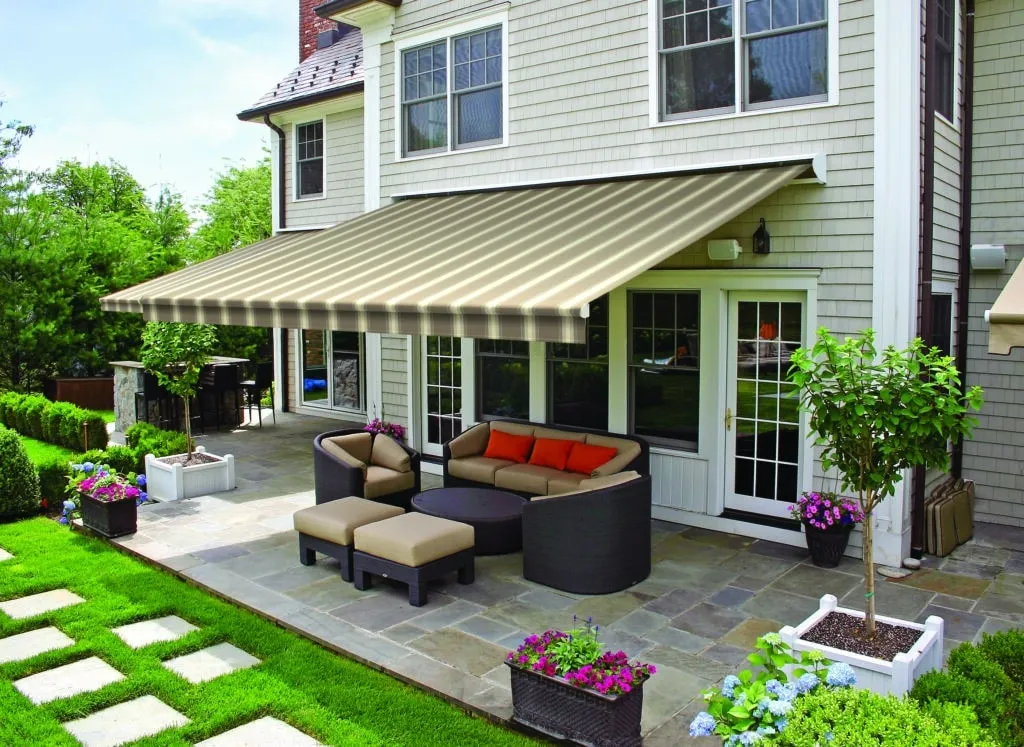

🏗️ Understanding Awning Wind Resistance & Structural Integrity
If you are planning to upgrade your patio, one crucial question will inevitably cross your mind: how much wind can an awning withstand before the structural integrity is compromised? You step onto your deck as a sudden, violent summer storm rolls in. You feel the sudden drop in temperature, listen to the heavy-duty acrylic fabric snap like a ship’s sail, and watch the thick aluminum lateral arms shudder under the immense kinetic pressure of the wind. Should you panic, or is your shade system built to handle this exact scenario?
⚠️ The Technical Reality
The truth is, determining how much wind an awning can handle isn’t just about guessing “how many miles per hour” it can take. It requires looking at its official wind resistance class (such as EN 13561 or DIN EN 13561).
📊 Wind Resistance Classification Standard
Generally, Class 1, 2, and 3 correspond to Beaufort forces 4, 5, and 6. Below is the breakdown of these technical ratings:
| Wind Class | Beaufort Force | Wind Speed (km/h) | Description |
|---|---|---|---|
| Class 1 | Force 4 | 20–27 km/h | Moderate Breeze |
| Class 2 | Force 5 | 28–37 km/h | Fresh Breeze |
| Class 3 | Force 6 | 38–48 km/h | Strong Breeze |
🧩 Beyond the Laboratory: Real-World Factors
However, laboratory numbers only tell half the story. The actual real-world wind tolerance heavily depends on:
- The product’s architecture and surface projection.
- The structural integrity of your wall.
- The type of mounting hardware used.
- Whether you are utilizing an automated wind sensor.
💡 Consultant’s Insight
“In my 15 years of consulting on outdoor shading, I’ve seen beautifully crafted awnings ripped from hollow brick walls simply because the environmental physics were misunderstood.”
🛡️ Protecting Your Investment
This comprehensive guide will decode the engineering behind wind ratings, explain how to choose the right system for your local climate, and provide actionable tips to protect your investment from catastrophic weather damage.
🌬️ Quick Answer: How Much Wind Can An Awning Withstand Safely?
| Classification | Beaufort Scale | Maximum Wind Speed |
|---|---|---|
| Class 1 | Beaufort 4 | Up to 27 km/h |
| Class 2 | Beaufort 5 | Up to 37 km/h |
| Class 3 | Beaufort 6 | Up to 48 km/h |
🚀 Expert Rule of Thumb
The moment the wind exceeds your product’s specific rated value, you should immediately retract the awning. This is especially critical for lateral folding arm awnings, which act as giant sails capable of generating massive uplift forces.
🚩 Awning Wind Rating Overview: The Beaufort Connection
National Weather Service (NWS) uses the Beaufort Wind Scale
to estimate wind speeds based on visual observations. Here is how international awning standards map directly to the weather outside your window:
| Wind Class (EN 13561) | Beaufort Scale | Wind Speed (km/h) | Typical Wind Description | Is It Safe to Leave Open? |
|---|---|---|---|---|
| Class 0 | 0 – 3 | Under 20 km/h | Gentle breeze. Leaves rustle. | Do not use in windy conditions. |
| Class 1 | Beaufort 4 | 20 – 27 km/h | Moderate breeze. Dust and loose paper raised. | Safe for standard residential use. |
| Class 2 | Beaufort 5 | 28 – 37 km/h | Fresh breeze. Small trees begin to sway. | Safe for premium folding arm awnings. |
| Class 3 | Beaufort 6 | 38 – 48 km/h | Strong breeze. Large branches in motion. | Safe for Pergolas and Zip screens. |
⚠️ Safety Disclaimer
Always prioritize physical safety over product usage. If wind speeds are approaching the limit of your awning’s class, retract the system immediately to prevent mechanical failure or property damage.
🔍 What Does an Awning Wind Rating Mean?
📘 What is EN 13561 or DIN EN 13561?
EN 13561 is the European standard (widely adopted globally by top-tier manufacturers) that specifies the performance and safety requirements for external blinds and awnings.
When evaluating patio awning high winds capabilities, you should never trust a brochure that simply says “windproof.” You must look for a certified EN 13561 badge. This certification means the manufacturer has subjected the awning frame, fabric, and folding arms to rigorous, standardized dynamic wind load testing in a laboratory environment.
⚖️ What is the difference between Class 0, 1, 2, and 3?
The classes dictate the maximum static load the unit can survive without catastrophic failure:
| Class Rating | Safety Threshold & Application |
|---|---|
| Class 0 | The product has either not been tested, or it failed to meet the minimal requirements of Class 1. It should not be deployed if there is any noticeable wind. |
| Class 1 | Safe to use up to Beaufort 4. This is typical for budget-friendly, lightweight DIY awnings. |
| Class 2 | Safe to use up to Beaufort 5. This is the gold standard for high-quality residential retractable awnings featuring forged aluminum joints. |
| Class 3 | Safe to use up to Beaufort 6. You will typically only see this rating on highly engineered vertical zip screens or heavily reinforced pergola structures. |
💡 Pro Tip
Always verify the certification paperwork rather than relying on verbal “windproof” guarantees from sales representatives.
🌪️ What Factors Affect Awning Wind Resistance?
🏗️ Awning type
| Awning Configuration | Wind Behavior & Performance |
|---|---|
| Retractable Folding Arm Awnings | These extend horizontally with no front support. They are highly susceptible to “uplift” (wind getting under the canopy and pushing it upwards). |
| Window Awnings (Drop Arm) | Because they angle downwards at a steep pitch, wind tends to deflect off the fabric rather than lifting it. |
| Vertical Zip Screen Wind Rating | These screens run down the side of a patio. Because the fabric is locked inside side-channels via a zipper mechanism, they boast exceptional wind resistance, often easily hitting Class 3. |
| Pergola / Patio Roof Awning Systems | These feature robust front columns anchored to the deck. Because they are supported at four points instead of two, they are inherently the most wind-resistant fabric structures available. |
📏 Dimensions and projection
❗ Surface installation and fixing elements
This is the most critical, yet overlooked, factor. Manufacturers explicitly state that the EN 13561 rating is only valid if the installation is flawless.
- Concrete & Solid Brick: Provides maximum pull-out strength for stainless steel wedge anchors.
- Hollow Brick & Siding: Requires specialized chemical epoxy resins and threaded rods. If mounted poorly on hollow brick, the wind won’t break the awning; it will rip the bricks entirely out of your facade.
🌍 Location and environmental exposure
🚩 Are Retractable Awnings Safe in High Winds?
The short answer is: No, not if left unattended. Retractable awnings in gusty winds are beautiful lifestyle enhancements, but they are not hurricane shields.
⚙️ Why retractability increases vulnerability
🛑 Why you should retract them before reaching the rated limit
📸 Visual Safety Insight
[Image Insert: A modern retractable awning automatically rolling inward as dark storm clouds gather in the background. | Alt Text: A motorized awning with wind sensor automatically retracting during a sudden windstorm to prevent damage.]
| Condition | Action Recommended |
|---|---|
| Light Breeze | Safe Operation |
| Approaching Limit | Prepare to Retract |
| Gusty / Stormy | Retract Immediately |
🔌 Is a Motorized Awning Better for Windy Areas?
⚠️ Motorization does not always mean stronger structural integrity
A motorized awning and a manual hand-crank awning from the same manufacturer will often share the exact same aluminum frame, arms, and wall brackets. The tubular electric motor housed inside the roller tube does not increase the unit’s EN 13561 wind class.
🌀 Why a motorized awning wind sensor improves protection
Somfy, installing a 3D wire-free wind sensor changes the game.
Instead of merely measuring ambient wind speed, these advanced sensors attach to the front profile of the awning and measure 3D spatial vibration. If the awning starts bouncing violently up and down—indicating dangerous uplift—the sensor instantly cuts power to the extension limits and automatically rolls the awning safely into its cassette.
💰 Are wind speed sensors worth the investment?
| Scenario | Reason to Invest |
|---|---|
| Frequent Use | You use your patio frequently and want peace of mind. |
| Unattended Deployment | You often leave the house to run errands while the awning is deployed. |
| Geographic Risk | You live in coastal or high-altitude regions subject to sudden squalls. |
| High-Value Asset | You have invested over $3,000 in a premium motorized system and want to protect that investment from a 3-second catastrophic gust. |
🏆 Which Types of Awnings Have the Best Wind Resistance?
| Awning Type | Wind Resistance | Structural Characteristics |
|---|---|---|
| Folding arm awnings | Moderate (Usually Class 1 or 2) | They provide the highest level of residential comfort and aesthetic appeal with zero floor obstructions. However, because they are entirely cantilevered from the wall, they are the most sensitive to vertical wind uplift. |
| Window awnings (Drop-arm) | High | Because they are smaller and project downwards at steep angles (often up to 160 degrees), the wind aerodynamic profile is very low. They smoothly deflect gusts rather than catching them. |
| Vertical zip screen systems | Very High (Often Class 3) | These exterior roller shades travel down heavy-duty aluminum side tracks. A welded zipper on the fabric edge locks into a PVC insert inside the track. This prevents the fabric from blowing out of the guides. |
| Pergola awnings & Patio roofs | Exceptional (Class 3 / Beaufort 6+) | A pergola awning utilizes front support posts. Because the structure is anchored to both the house wall and the patio floor, it virtually eliminates the dangerous “lever effect” seen in standard folding arms. |
💡 Structural Engineering Note
The Vertical zip screen wind rating is unique because the fabric is locked inside side-channels via a zipper mechanism, making them incredibly robust against direct wind pressure.
🛠️ Choosing the Right System
Always consider your local micro-climate. If you live on a coastal cliff or a high-rise floor, a Pergola system or Zip screen is the only responsible choice for long-term safety.
✅ How to Choose the Right Awning for a Windy Area
| Step | Action Item & Buyer Strategy |
|---|---|
| 01 | Check the declared wind class: Explicitly ask, “Is this an EN 13561 Class 2 or Class 3 system?” If the vendor doesn’t know, walk away. |
| 02 | Request ratings based on your specific installation: Factory manuals assume perfect concrete walls. Ask the installer how mounting the awning to your wooden fascia board will impact the actual wind tolerance. |
| 03 | Consider local wind conditions: Review historical weather data for your neighborhood. Are you in a valley that acts as a wind funnel? |
| 04 | Ask about wind sensors and automatic retraction: Ensure the motor is compatible with highly sensitive, multi-directional motion sensors. |
| 05 | Confirm performance for specific sizes: A manufacturer might test a 10-foot awning to achieve Class 2, but their 20-foot version might secretly drop to Class 1. Verify the rating for your exact dimensions. |
💡 Final Strategic Advice
A high wind rating is a result of Engineering + Proper Installation + Active Monitoring. Never skip one to save on the other.
⚠️ What Happens If the Wind Exceeds the Awning’s Rating?
| Failure Stage | Physical Impact & Description |
|---|---|
| Fabric stress and fluttering | Initially, you will hear a loud, rapid snapping sound. The acrylic fabric will stretch, putting immense strain on the seams and the spline holding it to the roller tube. |
| Arm deformation | As uplift occurs, the folding arms are forced upwards past their horizontal limits. The heavy-duty springs inside the arms will groan, and the cast-aluminum elbow joints may permanently bend or shatter under the sheer stress. |
| Frame and fixing failures | If the arms don’t snap, the kinetic energy transfers directly to the wall brackets. Massive leverage can strip lag bolts out of wood studs or crack masonry, causing the entire 200-pound unit to crash onto the patio. |
| Shortened lifespan and safety risks | Even if the awning survives a severe storm without visible breakage, the micro-fractures in the aluminum and the stretching of the internal Kevlar cables will drastically reduce its operational lifespan. |
🚨 Critical Structural Warning
The kinetic force of wind increases exponentially with speed. A gust that is twice as fast exerts four times the pressure on your mounting brackets. Always retract your awning before the first sign of a storm.
🛡️ How to Protect Your Awning from Wind Damage
| Action Item | Expert Protocol & Maintenance Strategy |
|---|---|
| Retract it early | If the leaves on the trees are violently swaying (Beaufort 5), press the retract button. Never leave an open awning unattended. |
| Install a smart sensor | Equip your system with an accelerometer-based wind sensor and check its batteries annually. |
| Optimize installation | Insist on marine-grade stainless steel hardware. If installing on brick, demand chemical epoxy anchoring systems. |
| Avoid excessive projections | If you live on a windy bluff, do not order an awning with a 13-foot projection. Stick to a safer 10-foot projection to reduce leverage. |
| Routine Maintenance | Every spring, inspect the arm brackets, ensure the wall mounting bolts are tightly torqued, and check the fabric for micro-tears. |
💡 Proactive Care Summary
By following these five pillars of protection, you ensure that your outdoor shade system remains a source of comfort rather than a liability during storm season.
🏢 What Wind Rating Should You Choose for Different Projects?
| Project Type | Recommendation & Strategic Guidance |
|---|---|
| Best for small residential patios | Recommendation: Class 1 or Class 2. A standard retractable folding arm awning is perfectly adequate, provided you retract it during bad weather. |
| Best for balconies and high-rise terraces | Recommendation: Class 2 (Minimum). High altitudes generate severe updrafts. Consider opting for a slightly smaller width to maximize arm tension stability. |
| Best for coastal homes | Recommendation: Class 3. Coastal awning solutions demand maximum durability. Consider heavy-duty Pergola systems or Vertical Zip Screens that lock out the wind and salt spray. |
| Best for restaurants and cafes | Recommendation: Class 2 or 3 Motorized Systems. Staff cannot manually crank 5 awnings during a sudden downpour. Automated, high-class systems with synchronized wind sensors are mandatory. |
| Best for pergola-covered outdoor spaces | Recommendation: Class 3 Patio Roof Systems. For ultimate all-weather dining, fixed-post tensioned fabric systems offer the highest wind deflection on the market. |
📌 Pro-Buyer Note
For commercial settings, automation isn’t just a luxury—it’s a liability shield. Ensuring your systems retract automatically during a sudden squall protects both your patrons and your overhead furniture investment.
🏁 Final Verdict: How Much Wind Can An Awning Withstand?
Understanding exactly how much wind can an awning withstand goes far beyond simply memorizing a miles-per-hour number. It is an intricate balance of structural engineering, aerodynamic physics, and smart usage.
The most professional way to judge an awning is to look for its official Wind Resistance Class (EN 13561), while heavily factoring in the product type, overall dimensions, and the structural integrity of your home’s exterior wall.
🧠 The Smartest Strategy
For the vast majority of homeowners and commercial operators, the ultimate goal shouldn’t be to challenge Mother Nature by seeing how much punishment the hardware can take. Instead, the smartest strategy is to choose a high-quality Class 2 or Class 3 system suited for your local climate, properly anchor it to the wall, and utilize smart wind sensors to ensure the awning automatically folds away safely long before the storm hits.
| Factor | Final Determination |
|---|---|
| Standard Rating | Always verify the EN 13561 Certification. |
| Installation | Safety is only as good as the wall anchors used. |
| Automation | Sensors provide the ultimate failsafe against gusts. |
🚀 Looking to upgrade your outdoor living space?
Explore our highly-rated Motorized Awnings Collection featuring built-in wind sensor compatibility.
If you are still in the planning phase and need expert advice on structural integrity, read our comprehensive guide on How to Choose an Awning Manufacturer to ensure you invest in a product built to last.
❓ FAQs About Awning Wind Resistance
🤔 Can an awning stay open in windy weather?
No. Standard retractable awnings should never be left open in windy weather. They are designed for sun protection, not extreme weather deflection. Always retract them when the wind exceeds their EN 13561 class rating.
🌬️ Is Beaufort force 5 too strong for an awning?
Beaufort 5 (28-37 km/h) is the maximum safe limit for a high-quality, Class 2 retractable awning. If the wind reaches Beaufort 5, you should be actively monitoring the awning or retracting it to prevent sudden gust damage.
⚡ Are motorized awnings safer in the wind?
Yes, but only if they are equipped with an automatic wind sensor. The motor itself doesn’t make the frame stronger, but the sensor allows the awning to autonomously retract before a catastrophic gust breaks the arms.
📡 Do wind speed sensors actually work?
Yes. Modern 3D motion sensors are incredibly reliable. Rather than measuring wind speed, they measure the actual physical bouncing and vibration of the awning’s front bar, triggering a retraction the moment unsafe movement is detected.
🏖️ What is the best awning for coastal areas?
The best coastal awning solutions are Pergola Awnings (with front support posts) or Vertical Zip Screens. These systems prevent wind uplift, which is the primary cause of damage on coastal properties.
📏 Can larger awnings withstand the same wind as smaller ones?
Generally, no. A 20-foot wide awning catches significantly more wind than a 10-foot awning. Manufacturers often use thicker aluminum, but the sheer surface area makes larger awnings inherently more vulnerable.
🏗️ What is the highest wind rating for an awning?
The highest standard rating is Class 3 (EN 13561), which covers winds up to roughly 48 km/h (Beaufort 6). Fixed-post structural pergolas can sometimes be engineered to withstand higher wind loads depending on building codes.