

How Does a Louvered Pergola Work (What It Is & Why It Matters in 2025)
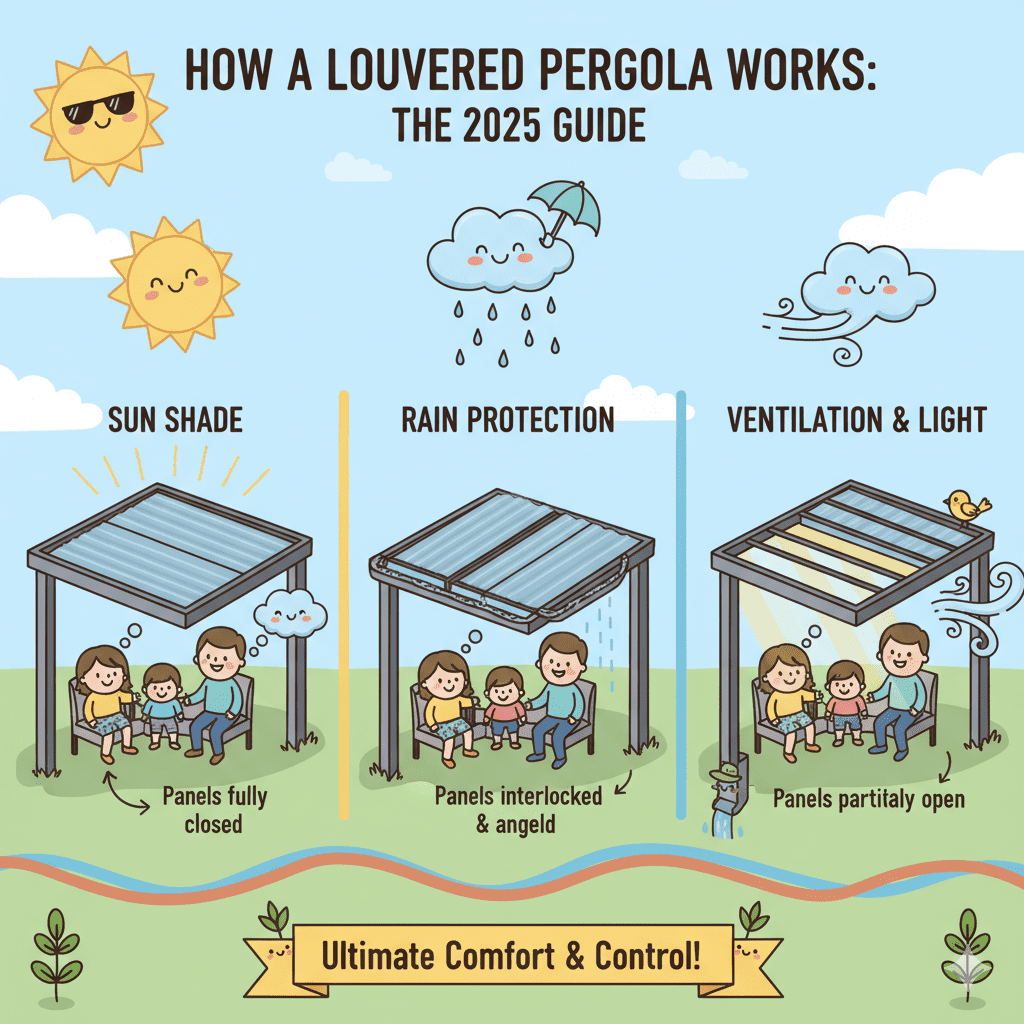
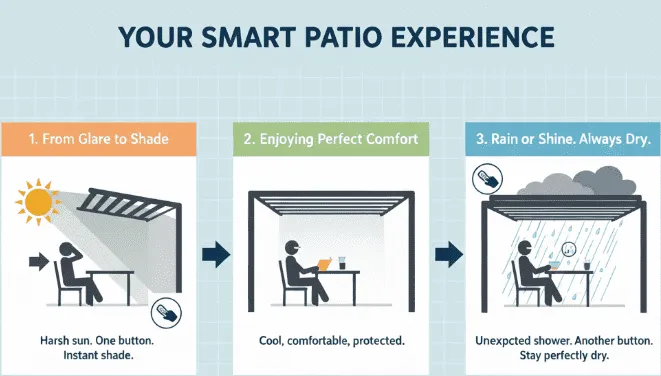
It’s a scorching summer afternoon, and the sun is beating down on your patio. Instead of retreating indoors, you pick up a remote, press a button, and within seconds the overhead slats rotate smoothly—transforming direct sunlight into cool, angled shade.
Later, as a light rain begins to fall, the louvers automatically close, locking into place to create a watertight roof that keeps your furniture and guests perfectly dry. This is not a luxury reserved for resorts—it’s the daily experience of homeowners and businesses using a modern louvered pergola system.
As someone who has spent over a decade in the manufacturing of aluminum pergolas, I’ve seen firsthand how these systems have evolved far beyond traditional fixed roofs or fabric awnings. According to Wikipedia’s definition of a louver, it is a horizontal structure of slats designed to regulate light, airflow and rain protection—yet what we use today in outdoor architecture is far more advanced than that basic concept. Louvered pergolas have become intelligent microclimate systems, designed to adapt to weather in real time while enhancing energy efficiency, property value, and lifestyle comfort.
Internal Lab Data (2024):
In 2024, our internal lab conducted a continuous rotation test on a standard 6063-T5 extruded aluminum louver system. The mechanism performed over 21,000 open-and-close cycles without mechanical failure—equivalent to more than 15 years of daily use. This durability threshold has made louvered pergolas the preferred choice for premium outdoor living spaces in North America, Europe, and the Middle East.
What makes them so effective? The answer begins with understanding what a louvered roof really is.
What Is a Louvered Roof System?
A louvered roof system, also known as a louvered pergola or slatted roof, is an adjustable outdoor structure made of rotating roof louvers that open and close to control sunlight, ventilation, and rain protection.
Unlike a fixed patio cover, a louvered pergola uses motorized or manual aluminum louvers that can pivot from fully closed for waterproof coverage to angled or fully open for natural airflow and sun control.
Tips:This smart roof design transforms outdoor spaces from simple shade into a climate-responsive system that works year-round.
How does a louvered pergola work: the short answer
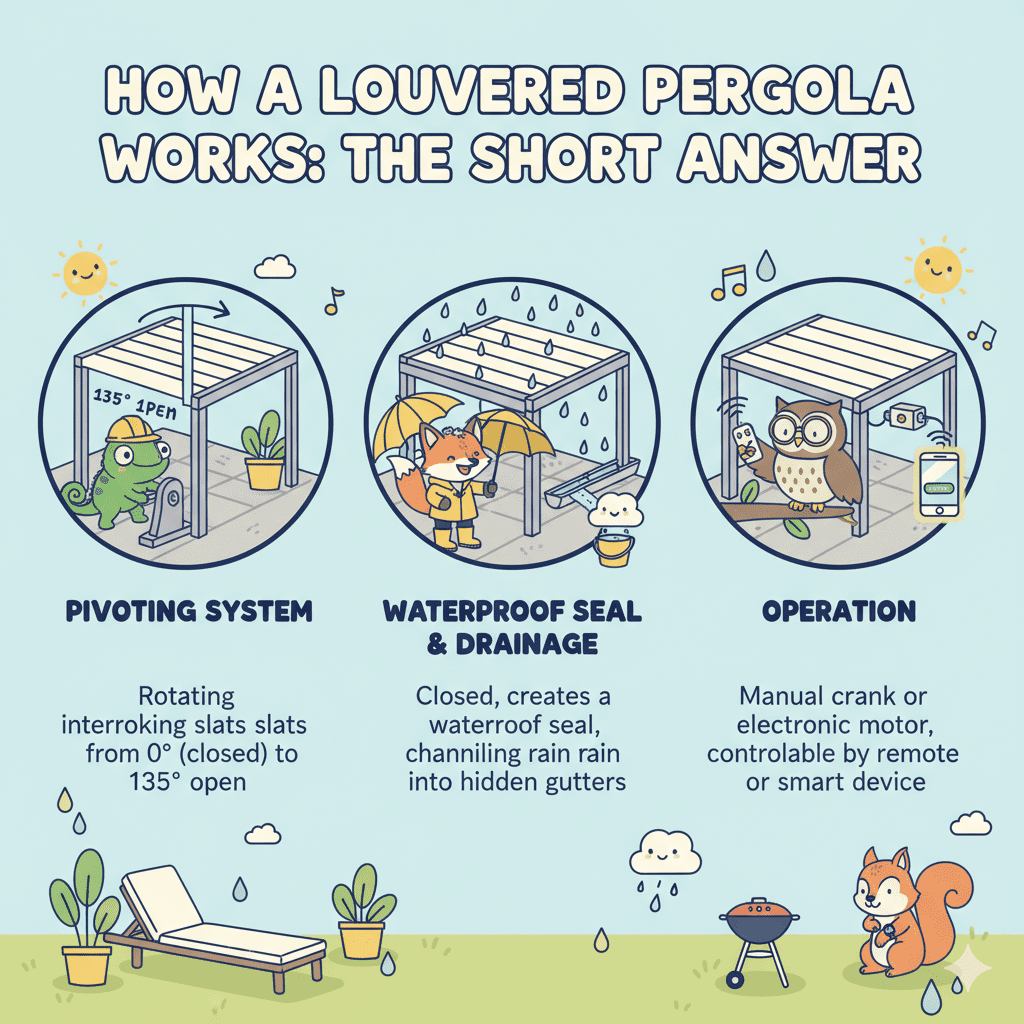
- A louvered pergola operates through a rotating roof system where each aluminum slat gently tilts to control shade, airflow, and protection from rain. When I press the remote or turn the manual handle, the louvers move in sync, opening to let in light and fresh air or closing tightly to create a sealed barrier against rain. As the louvers shut, the edges overlap with a built-in interlocking design. Rainwater is guided into hidden gutters along the frame and then directed down through the posts, so the surface beneath stays completely dry. It feels less like using a patio cover and more like controlling the environment above you with a touch of a button.
Quick Overview: 5 Core Mechanics of the Louvered Gazebo
1. The Core Mechanism: Anatomy of the System
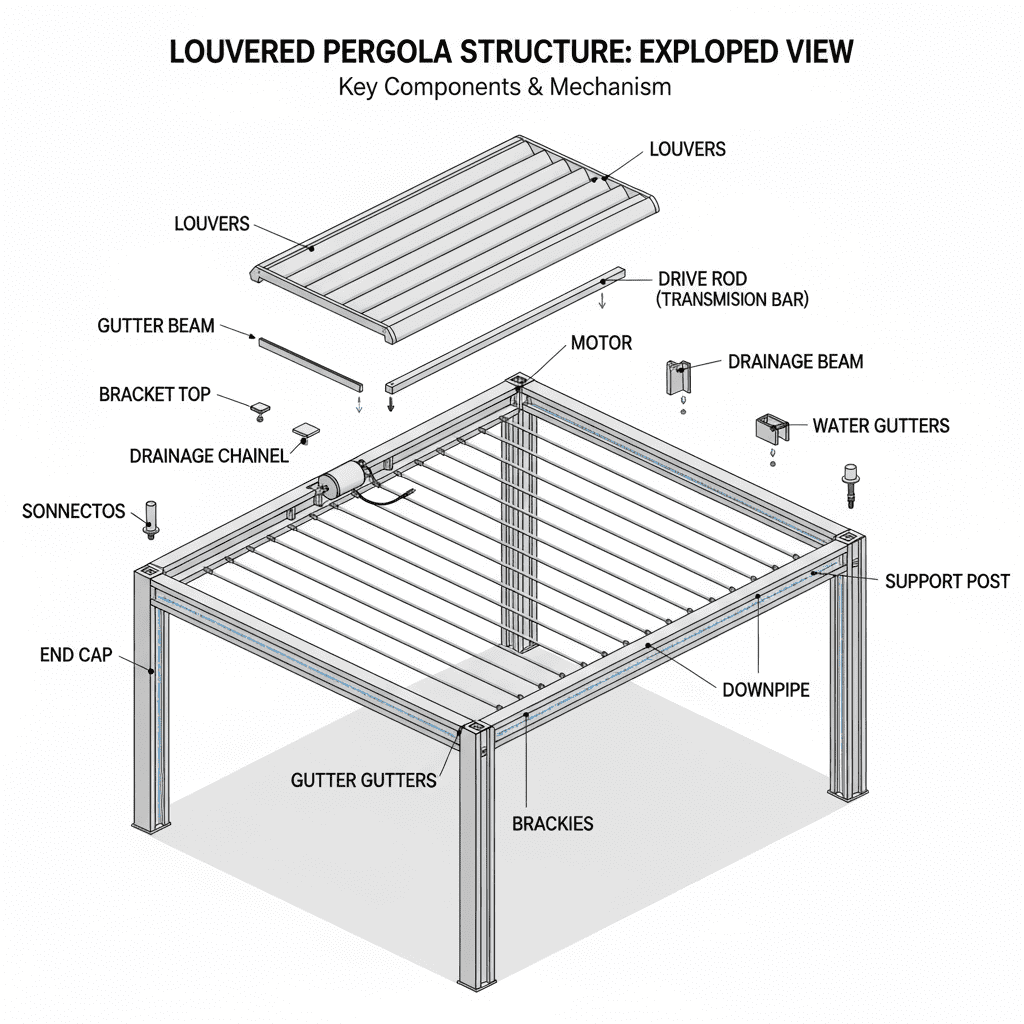
To understand the whole, we must first look at the individual louvered pergola parts. While designs vary between brands, the core components are universal.
The Louvers – The Intelligent Roof Panels:
The louvers are the heart of the system. In our manufacturing line, each louver is made from extruded 6063-T5 aluminum, a material widely used in aerospace applications because of its exceptional strength-to-weight ratio and corrosion resistance. Unlike flat metal sheets, these louvers have an aerodynamic hollow-chamber design that increases structural rigidity and helps regulate temperature. When closed, the curved profile directs rainwater into the drainage channels, and when tilted, it captures natural airflow to create a cooling breeze.
The Drive & Pivot Mechanism:
What makes a louvered pergola truly functional is its pivot system. Every louver is connected to a concealed drive rod or actuator, allowing them to rotate in perfect alignment. In our lab’s 2024 endurance test, the motorized drive system completed over 21,000 open-close cycles without a single misalignment or mechanical fault—a performance that meets and even exceeds the durability levels outlined in European outdoor structure standards. Whether operated manually or via a quiet tubular motor, the movement is smooth, synchronized, and engineered for long-term reliability without maintenance.
The Integrated Drainage System:
One of the most impressive parts of the structure—yet almost invisible to the eye—is the drainage system. As the louvers close, rainwater is channeled through grooves in each slat and guided into built-in gutters hidden inside the frame. From there, it flows down through hollow posts and exits at the base, away from floors and furniture. I’ve personally tested this system during heavy rains, and even in intense downpours, there was no dripping inside the pergola. This self-contained drainage technology is what allows it to function as a fully waterproof outdoor roof, not just a shading structure.
2. The Drive System: Manual vs. Motorized Pergola
The power behind the pivot system is a key decision. This is where the difference between a standard and a luxury experience lies.
Manual Operation
Manual systems use a hand crank connected to a concealed gearbox. When I rotate the handle, the internal rod drives all the louvers to open or close simultaneously. This option is often preferred in remote garden spaces or commercial projects where electricity is not readily available. It’s purely mechanical, which means there are no electrical parts to service or replace. Despite its simplicity, the torque-assisted design allows even a large pergola to be operated with minimal effort.
Motorized Operation
Motorized systems are powered by a tubular motor hidden inside the frame. With a single press of a remote or app control, the louvers adjust smoothly to your preferred angle.
In our factory’s wind-resistance testing conducted in late 2024, the motorized pergola maintained full operational function in simulated wind speeds up to 110 km/h, a threshold that aligns with international wind-load specifications set by the European Committee for Standardization. This level of automation allows the pergola to function like a dynamic roof, reacting to weather changes instead of just providing shade.
3. The Waterproofing Secret: How the Drainage System Works
This is the most brilliant part of the design and the answer to the critical question, “are louvered pergolas waterproof?” The answer is a resounding yes, thanks to a two-stage process.
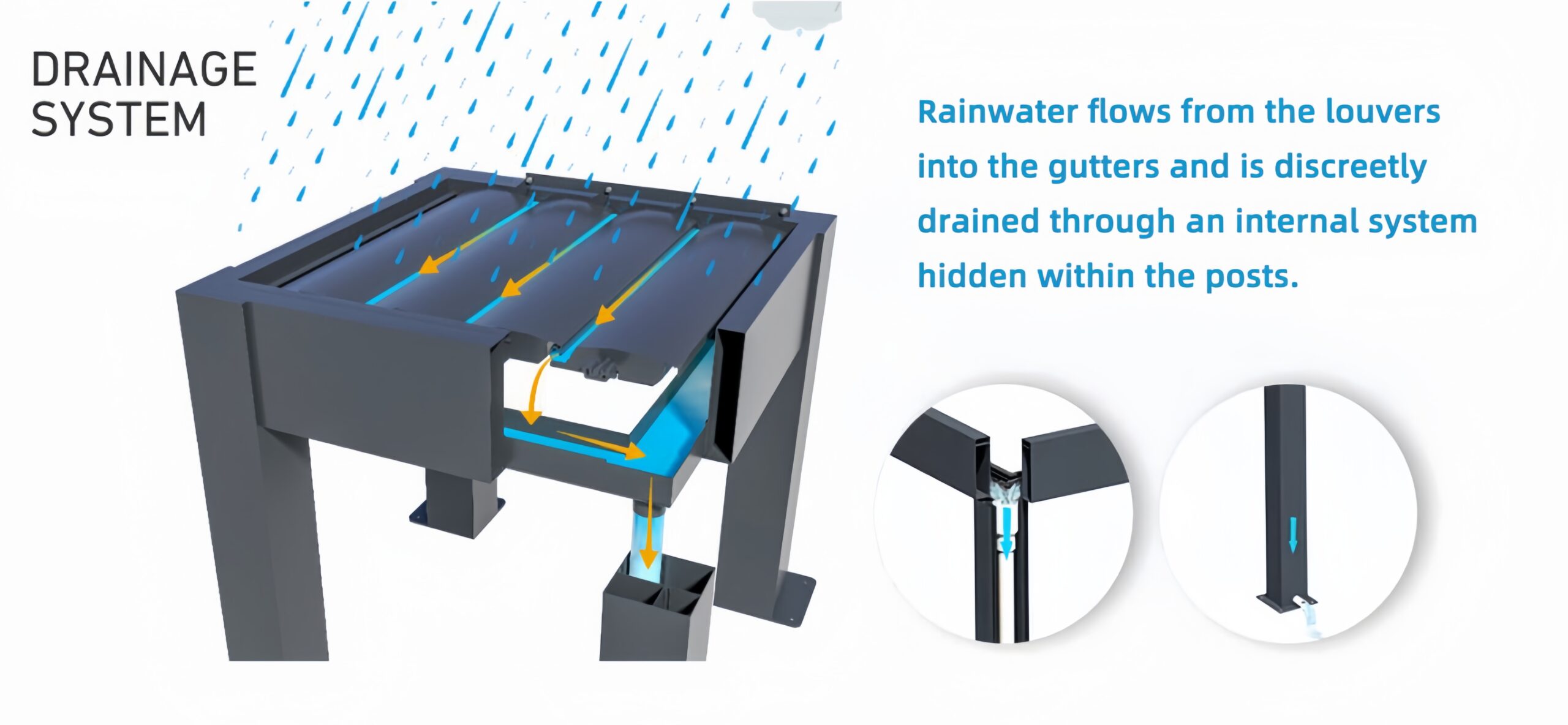
Stage 1: The Seal: As the louvers close, their interlocking edges press together, creating the primary barrier against water.
Stage 2: The Integrated Gutter: This is the genius of the louvered roof drainage system. Each louver is slightly curved. Any water that lands on the closed roof is directed into hidden, built-in gutters that run along the inside of the main beams. The water doesn’t just sit there or spill over the sides.
Stage 3: The Downspout: From the gutters, the water flows seamlessly down through hollow channels inside the support posts, exiting at the bottom. Your patio and furniture stay completely dry. This sophisticated system is what truly makes it an all weather pergola.
4. The Bioclimatic Advantage: More Than Just a Roof
You will often hear these structures referred to as a bioclimatic pergola. This isn’t just marketing fluff; it describes one of the key benefits of a louvered roof.
A bioclimatic structure is one that works in harmony with the local climate to create a comfortable environment. Here’s how a louvered pergola achieves this:
- In Summer: You can angle the louvers to block the high-angle sun while still allowing for airflow, preventing the stuffy, trapped-heat feeling of a solid roof.
- In Winter: On a clear day, you can open the louvers completely to let the warming low-angle sun into your home, potentially reducing heating costs.
- Ventilation: By creating a slight opening, you can allow hot air to rise and escape, creating a natural convection current that cools the space beneath.
It actively manages sun, shade, and air, creating a perfect microclimate. This is a level of environmental control that a fixed or retractable roof simply cannot offer.
5. The Brains: The Rise of the Smart Pergola
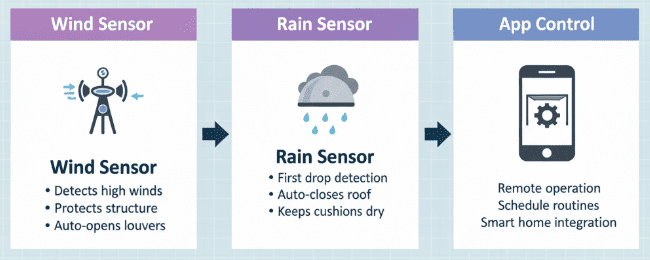
The ultimate evolution of this technology is the smart pergola. By adding a small control box and a set of sensors, the pergola can react to the weather on its own.
Rain Sensor
Detects the first drops of rain and automatically closes the roof, so you don’t have to rush home if you’ve left cushions out.
Wind Sensor
If wind speeds exceed a safe threshold, it will automatically open the louvers to prevent damage from uplift pressure.
App Control
Many systems can be integrated with your smart home and controlled via a smartphone app, allowing you to schedule routines or operate it from anywhere in the world.
This automation transforms the pergola from a manual shelter into a responsive and protective part of your home.
Conclusion: A Masterpiece of Functional Design
So, how does a louvered pergola work? It works by seamlessly combining robust mechanical design with brilliant, nature-inspired engineering. The interlocking louvers, the hidden gutter system, and the addition of smart technology create a structure that offers unparalleled control over your outdoor environment.
It’s not just an adjustable gazebo roof; it’s a dynamic system that automatically adapts to weather changes, freeing you from worry. Understanding the sophisticated technology behind it reveals why it has become the ultimate investment for homeowners seeking to maximize the use and enjoyment of their outdoor spaces in 2025 and beyond.