
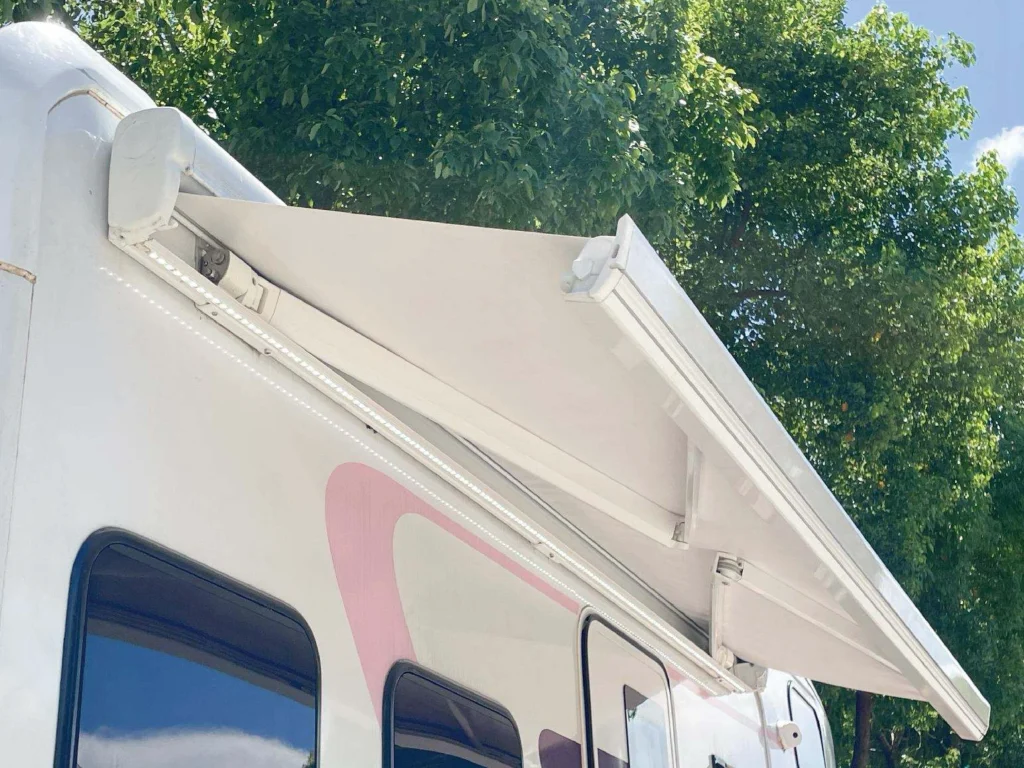

🚐 Introduction: The DIY RV Awning Replacement
There is nothing quite like pulling your rig into a beautiful campsite, leveling the jacks, and deploying your patio awning to create the perfect shaded oasis. But what happens when you press that button or pull that strap, and you are greeted by shredded fabric, severe mold, or sun-baked vinyl that cracks like a potato chip? Learning how to replace an rv awning fabrics is a rite of passage for any serious RVer.
If you are reading this, you are likely staring at a damaged awning and wondering, “Can I do this myself, or do I need to pay a dealership $1,000?” The good news is that with a couple of friends, the right tools, and a healthy respect for spring tension, completing a DIY RV awning replacement is entirely achievable.
In this ultimate, comprehensive guide, we are going to walk you through exactly how to change RV awning fabric safely and efficiently. We will cover everything from diagnosing the damage and choosing between vinyl or acrylic, to handling the terrifying torsion springs and sliding the new fabric into place without tearing it. Let’s dive deep into the mechanics of RV awnings and get your patio space back in pristine condition.
🔄 Why Do You Need to Replace Your RV Awning Regularly?
Awnings are subjected to the harshest environments possible. They face blazing UV rays in the desert, torrential downpours in the mountains, and whipping winds on the coast. But how do you know when it is time to stop patching and start replacing?
☀️ 1. Severe UV Degradation and Sun Rot
The most common killer of an RV awning is the sun. Over years of exposure, the UV rays break down the plasticizers in standard vinyl fabrics. If your awning feels brittle, stiff, or leaves a powdery residue on your hands when you touch it, the structural integrity is compromised. Sun rot usually attacks the first 12 inches of the fabric—the part that remains exposed to the sun even when the awning is rolled up.
🌧️ 2. Micro-Tears, Pinholes, and Delamination
If you sit under your awning on a sunny day and look up, do you see a constellation of tiny stars? Those pinholes mean the waterproofing layer has failed. Water will seep through, and more importantly, a gentle gust of wind can easily turn a pinhole into a massive, unrepairable tear. Replace camper awning fabric immediately if delamination (layers of the fabric separating) occurs.
🦠 3. Uncontrollable Mold and Mildew
While surface mildew can be removed with bleach and elbow grease, deep-rooted mold that has penetrated the woven fibers of the fabric cannot. Not only does this look terrible and smell awful, but it can also pose respiratory health risks when you are lounging underneath it.
✨ 4. Aesthetic Upgrades and Resale Value
Sometimes, your old awning is just ugly. Faded 1990s teal stripes might not match your newly renovated rig. An all-weather RV awning fabric replacement is one of the fastest ways to modernize the exterior of your camper, drastically increasing its curb appeal and resale value.
⛺ Understanding Your RV Awning Materials: Vinyl vs. Acrylic
Before you order a replacement, you must understand what you are buying. Not all heavy duty RV awning fabrics are created equal. Let’s evaluate the two primary materials.
💧 Standard Vinyl Awnings
Vinyl is the most common material shipped on factory RVs. It consists of a woven polyester base coated with liquid vinyl.
Pros: It is 100% waterproof. If it rains, the water will pool and run off without soaking through. It is also generally cheaper and easier to clean.
Cons: Vinyl traps heat. Sitting under a vinyl awning in Arizona can feel like sitting in an oven. Furthermore, it is prone to cracking in freezing temperatures and attracts mildew if rolled up wet.
Perfect For: The weekend warrior who camps primarily in rainy or humid climates and wants an affordable, waterproof shelter.
🌬️ Woven Acrylic Awnings
Acrylic awnings (like premium Sunbrella fabrics) are woven from dyed yarn.
Pros: They are highly breathable, allowing hot air to escape through the fabric, making the area underneath significantly cooler. They are also incredibly resistant to UV degradation and will not crack or stiffen over time.
Cons: They are water-repellent, not waterproof. In a heavy downpour, water might mist right through the fabric. They are also more expensive.
Perfect For: The full-time RVer or those who frequent the scorching climates of the American Southwest, prioritizing shade and airflow over rain protection.
💰 RV Awning Replacement Cost: DIY vs. Professional
Let us talk numbers. Why are you undertaking a DIY RV awning replacement?
🏢 The Professional Route
If you take your rig to an authorized RV service center, they will charge you retail price for the fabric (usually $300 – $600 depending on length) plus 2 to 4 hours of labor at $150+ per hour. The total cost easily ranges from $800 to $1,200.
🛠️ The DIY Route
If you choose the DIY route, you only pay for the replacement fabric (around $150 to $350 online for a high-quality aftermarket brand) and a few basic tools.
The savings are massive, making this one of the highest ROI maintenance tasks you can perform on your rig.
[External Link: For specific safety regulations regarding RV exterior components, you can always consult the standards published by the Recreational Vehicle Industry Association (RVIA).]
📏 Pre-Installation: How to Measure for Your New Awning
One of the most devastating mistakes you can make is ordering the wrong size fabric.
🚫 Do NOT measure the old fabric. The old fabric has likely stretched, shrunk, or warped over the years.
✅ Instead, to get the correct measurement:
- Grab a reliable tape measure.
- Measure from the center of the front awning arm to the center of the rear awning arm.
- If this measurement is exactly 16 feet, you need a “16-foot awning replacement.”
Note: The actual fabric you receive will be roughly 15 feet 2 inches wide. Manufacturers size their awnings based on the hardware center-line distance, not the raw fabric width.
🛠️ Steps to Replace an RV Awning: The Ultimate 7-Step Guide
Are you ready to get your hands dirty? The following procedure applies primarily to standard manual torsion-spring awnings (like Dometic and Carefree of Colorado), though the basic principles of motorized RV awning replacement are incredibly similar.
Disclaimer: Torsion springs hold immense rotational energy. Follow the pinning instructions meticulously. If you feel uncomfortable, stop and hire a professional.
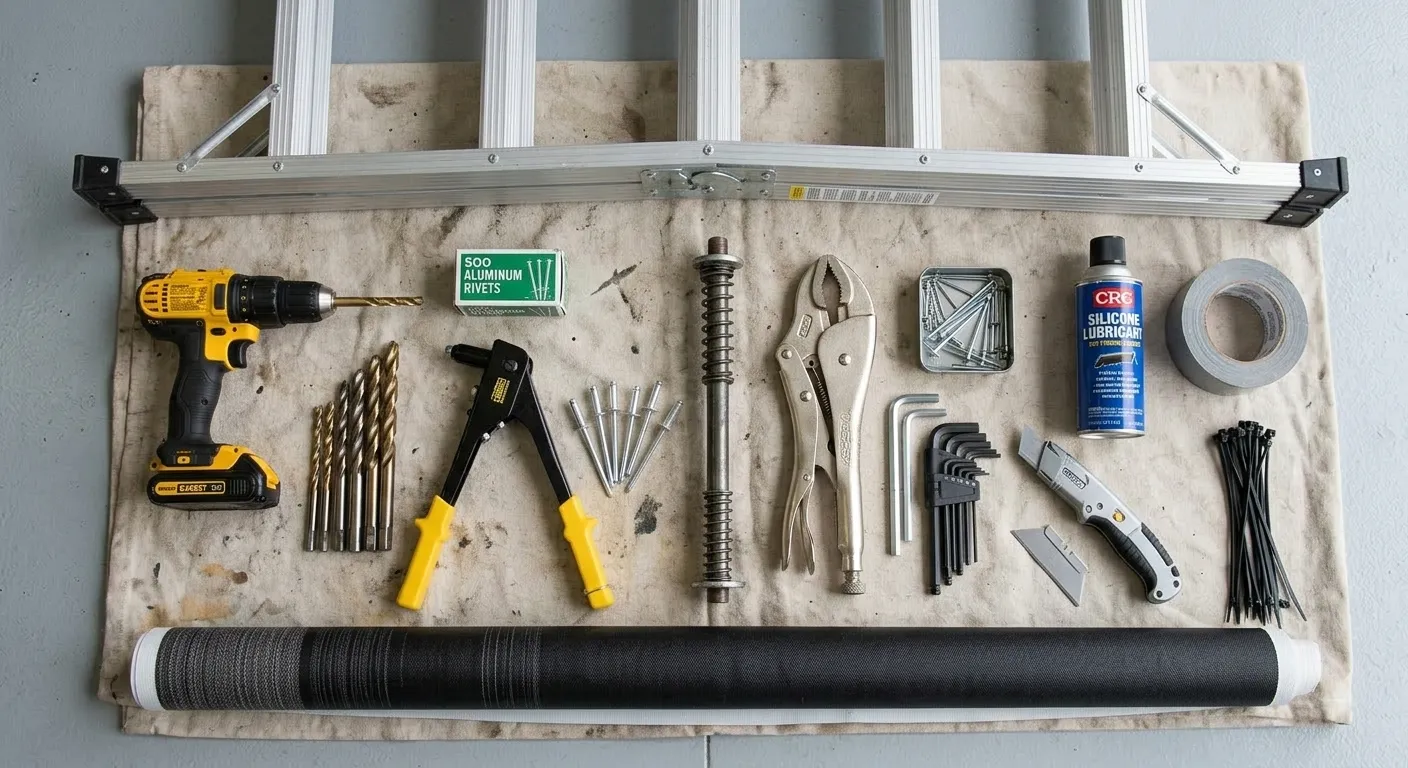
🧰 Essential Tools Required for Replacing an RV Awning
Before starting, assemble your “weaponry.” Having everything within arm’s reach is critical when you have two friends holding a 100-pound aluminum tube.
- Two Stepladders: Ensure they are tall enough to reach the RV roof rail comfortably.
- Power Drill and Drill Bits: Specifically a 3/16″ bit for drilling out old rivets.
- Pop Rivet Gun: With 3/16″ pop rivets (ensure they are aluminum, not steel, to prevent galvanic corrosion).
- Vise Grips (Locking Pliers): Absolutely essential for safely gripping the torsion rod.
- Cotter Pins or Allen Wrenches: To lock the spring tension (usually 1/8″ or 5/32″ diameter).
- Silicone Lubricant Spray: Do not use WD-40. Silicone will make the track slippery without degrading the new fabric.
- Utility Knife / Box Cutter: For slicing the old awning.
- A Helper (or Two): This is a 2 to 3-person job. Do not attempt this alone.
- Duct Tape & Zip Ties: Because no RV project is complete without them.
Step 1: Secure and Pin the Awning Springs (Crucial Safety Step)
This is the most critical step in the entire process. Inside the aluminum roller tube are heavy-duty torsion springs. If released improperly, they can spin rapidly, breaking fingers or wrists.
First, unroll your awning about one foot out from the RV. Look at the end caps (the cast metal pieces at the ends of the roller tube). On the end cap, you will see a small hole or a slot.
You need to rotate the tube slightly until that hole aligns with the hole in the internal shaft. Once aligned, insert your cotter pin (or a sturdy Allen wrench) entirely through the hole.
This mechanically locks the spring, preventing it from unwinding.
Note for Dometic vs Carefree: Dometic awnings usually have springs on both ends. Carefree RV awning replacement might only require pinning the front side. Check your specific manufacturer’s manual.
Step 2: Remove the Awning Roller Tube from the RV
With the springs safely pinned, it is time to detach the awning from the RV.
Have Person A stand on a ladder at the front arm, and Person B stand on a ladder at the rear arm.
At the top of the awning arms, locate the lag bolts attaching the arm to the roofline, or the bolts holding the roller tube bracket to the arm arm. Remove the bolts securing the tube assembly.
Simultaneously, lift the roller tube assembly off the hardware arms.
Carefully walk the heavy aluminum tube away from the RV and place it on a pair of sawhorses or safely on a clean patch of grass.
Hands-on Experience: I still remember a frustrating moment during my first replacement. We forgot to bring the sawhorses out beforehand. Standing there holding a 100-pound, 18-foot metal tube while screaming at my brother to fetch the sawhorses was a recipe for disaster. Set up your workspace before you lift the tube!
Step 3: Drill Out Rivets and Remove Hardware
Now that the tube is on the ground, you must remove the end cap to get the old fabric off.
Focus on the end of the tube where the locking lever is located (usually the right/front side).
Use your power drill with a 3/16″ bit to carefully drill out the heads of the pop rivets holding the end cap to the aluminum tube.
Once the rivets are drilled out, you will need to pull the end cap off.
WARNING: Even though the spring is pinned, treat it like a loaded gun. Use a marker to draw a line across the end cap and the tube so you know exactly how they align later. Pull the cap (with the spring assembly attached) straight out and set it safely aside.
Step 4: Slide Out the Old Awning Fabric
With the end cap removed, the tracks holding the fabric are exposed.
Often, the easiest way to remove the old fabric is to take your utility knife and simply slice the old fabric right down the middle, separating the main canopy from the small valance.
Grab the end of the fabric and pull it straight out of the aluminum track. If it has been sitting baking in the sun for ten years, it might be stubborn. Grip the fabric firmly, pull sharply, and listen for the distinct ripping sound as the old poly-cord slides free.
Once the tube is empty, take a moment to inspect the aluminum tracks. Use a flathead screwdriver to gently scrape out any dirt, crystallized salt, or debris.
Step 5: Clean, Lubricate, and Insert the New Fabric
This is where the magic happens. Your new fabric will come folded in a box. Unfold it completely on a clean surface. Identify the top side (the patterned side) and the poly-cords sewn into the edges.
Lubricate: Take your silicone spray and heavily lubricate the tracks on the aluminum roller tube, as well as the awning rail still attached to your RV. This dramatically reduces friction.
The Taco Method: Fold the new fabric slightly so you can feed both the valance poly-cord and the main canopy poly-cord into their respective channels simultaneously.
Feed and Pull: Person A feeds the fabric into the grooves at the end of the tube, ensuring it does not snag on the sharp drilled metal edges. Person B stands at the other end, gently but firmly pulling the fabric down the length of the tube.
Center the fabric perfectly on the tube by measuring the bare aluminum left on both ends.
Step 6: Reattach the Hardware and Rivet the End Caps
With the new fabric centered, carefully slide the spring/end cap assembly back into the roller tube.
Align the sharpie marks you made earlier to ensure the lever is in the correct position.
Insert new 3/16″ aluminum pop rivets into the holes and use your pop rivet gun to secure them. You will feel the tension build as you squeeze the rivet gun handles, followed by a sharp “POP” as the mandrel snaps off, leaving a perfectly secured end cap.
Step 7: Remount the Tube and Attach to the RV Rail
Now comes the trickiest part: getting the whole assembly back onto the rig.
Carry the tube back to the RV.
Have Person A feed the main poly-cord of the awning fabric into the awning rail attached to the RV’s roofline. Just like the tube, spray this track generously with silicone.
Person B pulls the tube along the side of the RV as Person A feeds.
Once the fabric is centered on the RV, reconnect the roller tube to the awning arms using the bolts you removed in Step 2.
Releasing Tension: Grip the awning tube tightly with vise grips to control the rotational force. Hold it firmly, remove the cotter pin, and slowly let the vise grips rotate to transfer the spring tension back to the awning system.
Test the awning by rolling it out and in a few times. If it rolls up unevenly, simply deploy it fully, and gently tug the fabric horizontally along the RV rail to square it up, then install small self-tapping screws at the top rail to lock the fabric permanently in place.
⚠️ What Precautions Should Be Taken When Replacing an RV Awning?
While the steps above are straightforward, the environment and mechanical variables can make this dangerous. We cannot emphasize safety enough.
⚙️ Precaution 1: Respect the Kinetic Energy of Torsion Springs
Torsion springs hold upwards of 150 lbs of rotational force. If a vise grip slips or a cotter pin snaps, the end bracket will spin at a blinding speed. If your hand is in the way, it will result in shattered bones. Always double-check that your pinning tools are made of hardened steel (never use a cheap, bendable wire).
🌬️ Precaution 2: Never Work in Windy Conditions
An unrolled, unattached awning fabric acts exactly like a massive sail. Even a 10 mph gust of wind can easily catch the 15-foot piece of vinyl, pulling you off your ladder and slamming the aluminum hardware against the fiberglass side of your RV. Check the weather forecast; pick a calm, still morning for this project.
🧪 Precaution 3: Avoid Galvanic Corrosion
When reinstalling the end caps, you must use aluminum pop rivets, not steel. Putting steel rivets into an aluminum tube will cause a chemical reaction known as galvanic corrosion, which will eventually eat away at the metal, causing the end cap to fail catastrophically while driving down the highway.
✂️ Precaution 4: Protect the Fabric from Sharp Edges
When sliding the new fabric onto the roller tube, the edges where you drilled out the rivets are incredibly sharp. Wrap a small piece of duct tape around the sharp edges before sliding the fabric, or use a metal file to smooth down the burrs. The sharp, acrid smell of old, sun-baked vinyl is gone; don’t ruin the fresh smell of your new fabric by slicing it on day one.
🪜 Precaution 5: Proper Ladder Safety
You are working at heights of 10 to 13 feet, holding heavy, awkward objects. Ensure your ladders are on flat, stable ground. Never overreach; if you need to pull the fabric further, climb down and move the ladder.
🛡️ How to Maintain Your New RV Awning for Maximum Longevity
You just spent hours and a decent chunk of money replacing your awning. How do you make sure this one lasts 10 years instead of 3?
💧 Never Roll It Up Wet:
If a rainstorm forces you to roll up the awning to protect it from wind, unroll it as soon as the weather clears to let it dry completely. Rolling up a wet awning is a guaranteed recipe for severe mold and mildew within days.
🧼 Regular Cleaning with Safe Products:
Do not use harsh detergents, bleach, or abrasive brushes. Use a specialized RV awning cleaner or a mild mixture of Dawn dish soap and water. Use a soft-bristle brush on an extension pole to gently scrub the fabric twice a year.
⚙️ Lubricate Moving Parts:
The fabric isn’t the only thing that needs love. Use silicone spray or dry graphite lubricant on the sliding arms, knobs, and locking mechanisms to ensure smooth deployment.
🛣️ Tension the Fabric:
Before leaving your campsite, ensure the awning is rolled tightly. A loose roll will billow while driving down the highway at 65 mph, causing the fabric to constantly snap against the tube, eventually weakening the seams.
🏁 Conclusion
Tackling an rv awning replacement might seem like a daunting task reserved for professional mechanics, but as we’ve demonstrated in this guide, it is simply a matter of understanding the mechanics, respecting the safety protocols, and following a systematic approach.
By taking the DIY route, you are not only saving hundreds of dollars but also gaining an intimate understanding of your rig’s exterior systems.
You now know exactly how to diagnose sun rot, choose the right heavy duty RV awning material, handle torsion springs like a pro, and maintain your fresh fabric for years to come.
Do not let a ripped, moldy piece of fabric ruin your campsite aesthetic or limit your outdoor living space.
Gather your tools, bribe a couple of friends with some cold beverages, and upgrade your rig today!
(Happy camping, and may your awning always be perfectly taut and your shade refreshingly cool!)
💡 Frequently Asked Questions (FAQ)
To make this the ultimate guide, we have compiled the most common questions users ask about RV awning replacement.
🛑 Q: Can one person replace an RV awning alone?
A: No. It is highly discouraged and extremely dangerous. The sheer length and weight of the roller tube, combined with the necessity of feeding the fabric into tracks simultaneously, require at least two, preferably three, adults.
⏱️ Q: How long does it take to replace the fabric?
A: For first-timers doing a DIY rv awning replacement, expect the project to take between 2 to 4 hours from start to finish. Experienced technicians can do it in under an hour.
🔧 Q: What is the difference between Dometic and Carefree awning replacements?
A: The fabric materials are largely the same, but the hardware differs. Dometic awnings typically use torsion springs on both ends of the roller tube, while Carefree awnings often use a spring on only one side. Always refer to your specific manufacturer’s manual for pinning procedures.
⚙️ Q: Will replacing the fabric fix an awning that won’t roll up?
A: No. If your awning refuses to roll up, the issue is not the fabric; it is a broken internal torsion spring or a failed locking cam mechanism. You will need to order replacement springs and install them inside the tube.
🔄 Q: How do I know the correct spring tension when reassembling?
A: When you release the vise grips, the factory tension stored in the spring takes over. If you accidentally lost tension (unwound the spring completely), you will need to manually rewind it. Generally, an 18-foot awning requires about 13-15 full rotations of the end cap to achieve proper tension. However, always consult your specific manufacturer’s spec sheet.