
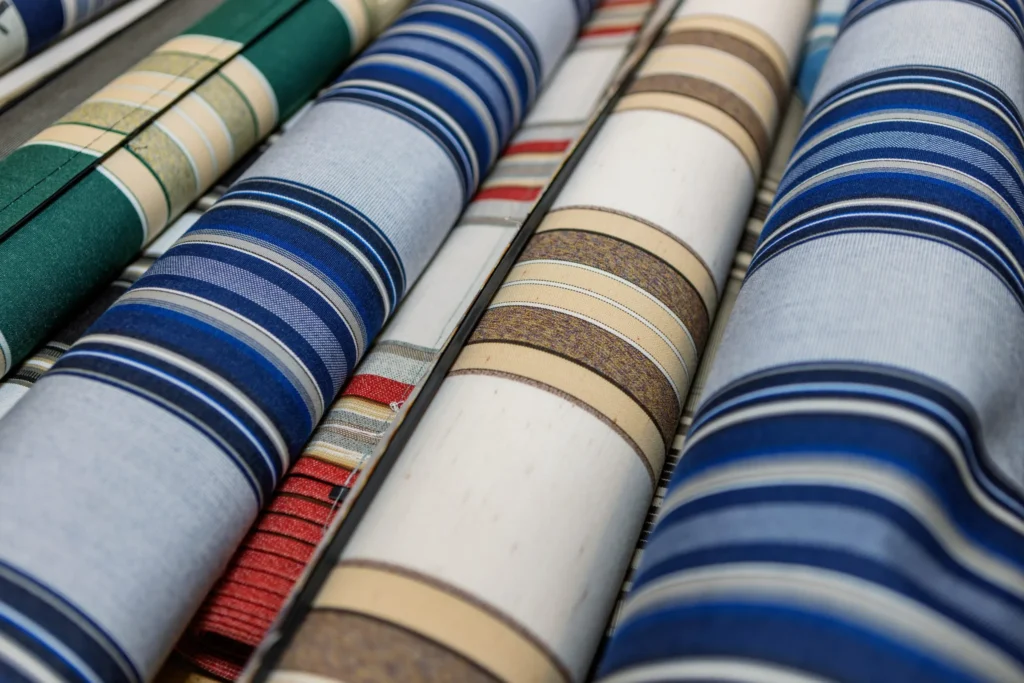

🧵What “awning fabric” means and why material matters
🔬 The Definition
When we discuss awning fabric, we are not simply talking about a piece of cloth strung over a metal frame. We are talking about highly engineered, architectural textiles designed to withstand the harshest environmental conditions on the planet. The term encompasses a wide variety of synthetic and composite materials, each subjected to rigorous chemical treatments and weaving processes to achieve specific performance metrics.
⚠️ Why does the material matter so much?
Because the fabric is the skin of your awning system. You could invest thousands of dollars in a state-of-the-art motorized frame, but if you choose the wrong textile, the system will fail.
- It will trap heat, creating a stifling greenhouse effect on your patio.
- It will succumb to UV degradation, turning a vibrant navy blue into a sickly, washed-out purple in a matter of months.
- It will sag, pool water, grow mildew, and eventually tear under wind loads.
💎 The Architectural Investment
The best fabric for outdoor awning applications is one that harmonizes with its specific microclimate. By understanding the molecular structure and manufacturing process of these textiles, you elevate your purchasing decision from a mere aesthetic choice to a long-term architectural investment.
🛡️Awning Fabric Functions
An awning fabric must simultaneously master four distinct, and sometimes conflicting, functions:
☀️ Shade and Thermal Control
The primary job is to block radiant heat. High-quality fabrics do not just cast a shadow; they actively reflect and absorb solar energy. A premium material can reduce indoor temperatures by up to 15 degrees if installed over a sun-facing window, significantly lowering air conditioning costs.
🌧️ Rain Protection
Depending on your climate, you may need a material that merely sheds a light drizzle or one that acts as an impenetrable shield against torrential downpours. Navigating the spectrum from water-resistant to fully waterproof is crucial.
🎨 Appearance and Aesthetics
Awnings are prominent architectural features. The fabric must hold its color, resist staining, and maintain its dimensional stability (not sagging or stretching) over a decade or more of use.
💪 Durability and Tensile Strength
The fabric is under constant tension. It must flex with the wind without tearing, endure the abrasive action of dust and debris, and resist the chemical breakdown caused by constant UV exposure.
🧵Types of Awning Fabric Materials
To make an informed decision, you must understand the core categories of awning fabric types available on the global market.
🎨 Solution-dyed acrylic awning fabric
Acrylic awning fabric is universally considered the gold standard for residential and high-end commercial applications. But the term “acrylic” alone is insufficient; it must be solution-dyed.
Think of a traditional piece-dyed fabric like a radish: red on the outside, but if you cut it open, the core is white. The color only sits on the surface. Solution-dyed acrylic, however, is like a carrot. Before the synthetic acrylic polymers are extruded into yarn, the liquid mixture is heavily saturated with UV-stable pigments. When the yarn is formed, the color runs all the way through the core.
Solution-dyed acrylic awning fabric is incredibly soft, mimicking the visual texture and drape of natural cotton canvas, but it possesses the rot-proof properties of a synthetic. It is highly breathable, allowing hot air to escape through the microscopic gaps in the weave, keeping the shaded area significantly cooler.
🧥 Polyester awning fabric (with coatings)
Polyester awning fabric is inherently stronger and more dimensionally stable than acrylic. It does not stretch as easily, making it an excellent base material. However, untreated polyester degrades quickly under UV light.
To make it viable for outdoor use, manufacturers create coated polyester awning fabric. A heavy-duty polyester woven scrim is passed through a bath of liquid acrylic or urethane resin. This coating protects the polyester core from the sun and provides a decent level of water resistance. It is generally more affordable than solution-dyed acrylic and offers bright, vibrant colors initially, though it may fade slightly faster over a ten-year lifespan since the color is typically in the coating, not the core fiber.
💧 Vinyl / laminated awning fabric
When extreme weather resistance is required, vinyl awning fabric enters the conversation. specifically, vinyl-laminated polyester.
This composite material is manufactured by sandwiching a high-strength polyester mesh (the scrim) between two solid sheets of Polyvinyl Chloride (PVC) film. These layers are fused together using massive heated rollers under extreme pressure. The result is a completely non-porous, 100% waterproof sheet.
🏭 Frontline Factory Experience: Conquering Delamination
Context: During my time overseeing production runs on the factory floor, we encountered a significant challenge with a massive batch of vinyl-laminated polyester destined for a national restaurant chain’s outdoor patios. The customer required an exact color match and supreme waterproof capabilities.
We ran 5,000 yards through our high-frequency welding machines to join the panels. However, during quality control testing in our accelerated weathering chamber (simulating 5 years of Florida sun and humidity in a few weeks), we noticed slight “delamination”—the vinyl layers were beginning to separate from the polyester scrim at the welded seams. This was a disaster in the making. If shipped, the awnings would fail in the field, filling with water pockets and peeling apart.
We immediately halted the entire production line. Our chemical engineering team traced the issue to “plasticizer migration” caused by the specific heat settings on our welding equipment interacting with a new dye formulation in the vinyl. We didn’t just tell the customer “it is what it is.” We proactively contacted the restaurant chain’s procurement directors, explaining the exact technical failure.
To solve it, we completely recalibrated the thermal pressure of our welding rigs, dropping the temperature by 15°C but increasing the dwell time by 2 seconds. More importantly, we internally absorbed the cost of adding a proprietary PVDF (Polyvinylidene fluoride) topcoat to the entire batch. This topcoat locked in the plasticizers and dramatically increased the bond strength. We delivered the project two weeks late, but with a product that tested to a 15-year lifespan instead of 10. The customer was so impressed by our transparency and the upgraded material that they signed a five-year exclusive supply contract with us.
🏗️ PVC-coated polyester awning fabric
While lamination sandwiches the mesh, PVC-coated polyester awning fabric involves dipping the polyester mesh directly into a vat of liquid PVC (plastisol). As it runs through the vat, the liquid PVC completely encapsulates every single yarn, filling all the microscopic holes.
It is then baked in massive ovens to cure the PVC. This process creates a fabric that is highly resistant to delamination because the coating is chemically bonded into the fibers, not just glued to the top and bottom. It is exceptionally strong, 100% waterproof, and very easy to clean. It is the workhorse of the commercial industry.
🌬️ HDPE shade mesh (shade cloth) vs traditional awning fabric
High-Density Polyethylene (HDPE) shade mesh is entirely different from traditional woven acrylics or solid vinyls. It is a knitted fabric full of intentional, tiny holes.
You will not use this for a solid roof that needs to block rain. Instead, HDPE is used for tension structures, pergolas, and vertical drop screens. The openness of the weave dictates how much light and air pass through. It provides exceptional UV blockage while allowing maximum airflow, making it the ultimate choice for scorching climates where rain protection is a secondary concern.
🏟️ High-end membrane options (PTFE / ETFE) for large structures
For monumental commercial projects, stadiums, and transportation hubs, standard awning fabrics fall short. Architects turn to advanced tensile membranes.
A prime example is architectural fabric woven from fiberglass and coated with Polytetrafluoroethylene (PTFE), widely known by the brand name Teflon. PTFE fiberglass is incredibly strong, entirely immune to UV degradation, and completely non-combustible. It has a lifespan exceeding 30 years and possesses self-cleaning properties, as rain easily washes dirt off its highly slippery surface.
📊Awning Fabric Performance Factors
When evaluating materials, you must look past the color swatch and dive into the technical specifications. These performance factors dictate the lifespan of your investment.
☀️ UV resistance and fade resistance
The sun is the ultimate destroyer of textiles. UV resistant / fade resistant awning fabric is non-negotiable. Ultraviolet rays bombard the fabric, breaking the chemical bonds in the dyes and the polymer chains of the fibers themselves (a process called photo-degradation).
To ensure you are getting a truly UV resistant awning fabric for patio use, look for materials that have been tested according to rigorous international standards.
For accurate benchmarking of UV resistance, the textile industry relies on testing protocols like the AATCC Test Method 169 (Weather Resistance of Textiles: Artificial Weathering). This standard subjects the fabric to controlled cycles of intense Xenon-Arc light (simulating sunlight) and moisture. A high-quality solution-dyed acrylic will maintain over 90% of its tensile strength and show virtually zero color change even after 1,500 hours of this brutal artificial weathering.
If you live in a high-sun environment like Arizona or Australia, choosing a highly fade resistant awning fabric for sunny climate (specifically solution-dyed acrylic) is the only way to ensure your awning doesn’t look decades old after a single summer.
💧 Water resistant vs waterproof (and what to choose)
The battle of water resistant vs waterproof awning fabric is the most common point of confusion for consumers.
- Water Resistant: This means the fabric (like acrylic) has a chemical finish that causes water to bead up and roll off. However, because it is woven, under sustained heavy rain or if water pools in a sagging spot, hydrostatic pressure will eventually force a fine mist of water through the microscopic holes in the weave.
- Waterproof: This means the fabric (like vinyl or PVC-coated polyester) is a solid, non-porous barrier. Water can sit on it indefinitely, and it will never penetrate.
We measure this using AATCC Test Method 127 (Water Resistance: Hydrostatic Pressure Test). A column of water is placed over the fabric, and pressure is increased until water penetrates. A waterproof awning fabric for rain (like coated vinyl) will withstand immense hydrostatic heads without leaking a drop, making it the required choice for commercial restaurant patios where diners must remain completely dry.
🌿 Mildew / mold resistance for humid climates
Mildew does not grow on synthetic fibers like acrylic or polyester; it grows on the dirt, pollen, and organic matter that gets trapped in the fabric.
However, a mildew resistant awning fabric is one that has been treated with highly engineered fungicidal finishes. If you live in a coastal area or a dense, damp woodland, a mildew resistant awning fabric for humid areas is vital. In these scenarios, PVC-coated polyester is often superior to woven acrylic because its smooth, plastic-like surface gives mold spores nowhere to anchor, allowing them to be easily washed away.
🌬️ Breathability and heat comfort
Breathability is the counterweight to waterproofing. A 100% waterproof vinyl fabric traps heat. The sun beats down on the vinyl, heating it up, and the hot air radiating beneath it cannot escape upward.
Woven acrylics, conversely, allow that hot air to rise through the fabric weave. If thermal comfort—creating a cool oasis on a hot afternoon—is your primary goal, breathability must take precedence over absolute waterproofing.
💪 Strength: tear resistance, wind performance
Awnings are essentially sails attached to your building. They face immense dynamic wind loads. The fabric must not tear.
Fabric strength is quantified using metrics like tensile strength and tear strength, often tested under ASTM D5034 (Standard Test Method for Breaking Strength and Elongation of Textile Fabrics). When dealing with high wind zones, coated polyester fabrics generally offer higher initial tear strength than soft acrylics. The fabric must stretch slightly to absorb wind gusts without catastrophic failure.
🔥 Fire retardant requirements (commercial use)
For residential patios, fire retardancy is rarely required by code. However, for commercial applications, choosing a fire retardant awning fabric is strictly enforced by local fire marshals.
A fire retardant commercial awning fabric is chemically engineered to self-extinguish. If a stray cigarette or a spark from an outdoor heater hits the fabric, it may melt a hole, but it will not burst into flames and spread the fire. Always check for certifications like the NFPA 701 or California State Fire Marshal Title 19 standards when outfitting a commercial building.
⚖️ Fabric weight / thickness (gsm/oz) and what it affects
Fabric is measured in ounces per square yard (oz/sq yd) or grams per square meter (gsm).
- For residential acrylics, a standard weight is around 9 to 9.5 oz. It provides a perfect balance of strength without overloading the retraction motors.
- When you look at a vinyl coated polyester awning fabric 13 oz / 18 oz, you are entering heavy-duty territory. An 18 oz vinyl is incredibly thick, highly puncture-resistant, and ideal for massive permanent structures or heavy snow-load areas. However, it is far too heavy and stiff to be used on standard retractable awnings.
☑️How to Choose the Best Awning Fabric
Selecting the right textile requires aligning the material’s properties with your specific reality.
🌍 Choose by climate (hot sun / heavy rain / coastal humidity / high wind)
Prioritize breathability and UV resistance. Solution-dyed acrylic is your champion here.
Prioritize absolute waterproofing. Vinyl laminated or PVC-coated polyester will keep the space dry.
Prioritize mildew resistance and easy cleaning. Smooth coated fabrics perform incredibly well against salt spray and fungal growth.
Prioritize dimensional stability and high tear strength. Heavy-duty coated polyesters are best, combined with a frame designed to handle the load.
🏗️ Choose by use case (patio, storefront, restaurant, RV, pergola)
- Home/Residential: The aesthetic and feel of the fabric are paramount. Awning fabric for home applications (like patio covers) overwhelmingly leans toward solution-dyed acrylics for their elegant, canvas-like look. Residential awning fabric must blend with the architecture.
- Commercial/Restaurant: Commercial awning fabric choices prioritize safety (fire retardancy), branding (bright, printable surfaces), and complete weather protection (waterproofing). Vinyls and PVCs dominate here.
- RV Awnings: This is a highly specialized category.
🚐 Frontline Factory Experience: The RV Shrinkage Crisis
The Crisis: Several years ago, our factory secured a major contract supplying RV awning fabric to one of North America’s largest motorhome manufacturers. We supplied a premium vinyl-laminated polyester. Six months into the rollout, we received frantic calls. Customers parked in the intense Arizona and Nevada heat were complaining that their awnings wouldn’t retract properly. The arms were jamming.
Our field technicians flew out and discovered a shocking issue: the fabric had shrunk. In some cases, the awning fabric is 10 inches shorter than arm measurement. The immense heat of the desert sun was causing the internal polyester scrim to contract, warping the entire vinyl composite.
Our engineers realized that during the lamination process, the polyester scrim was being held under too much longitudinal tension as it passed through the cooling rollers. It was essentially “frozen” in a stretched state. When the intense desert sun heated the vinyl, it softened, allowing the polyester underneath to violently snap back to its natural, shorter state.
To solve this, we completely re-engineered our production line. We installed a specialized “stenter frame” with an annealing oven. This allowed us to pre-shrink the polyester mesh using high heat while in a relaxed state before it ever met the vinyl layers. We also adjusted our automated cutting tables to implement a calculated 1.5% oversized tolerance for all RV cuts.
We coordinated with the RV manufacturer to ship thousands of free replacement canopies to their dealership network to swap out the faulty batches. It cost us dearly in the short term, but that level of accountability cemented a relationship that remains active to this day. When choosing RV awning fabric, always ensure the manufacturer specifically tests for heat-induced dimensional stability.
🧹 Choose by maintenance preference (easy-clean vs fabric feel)
- Do you want a fabric that looks like luxurious natural cotton but requires gentle, specialized cleaning? Choose acrylic.
- Do you want a fabric that you can aggressively scrub with strong cleaners or simply blast off with a hose because it has a shiny, plastic surface? Choose vinyl.
💰 Choose by budget and expected lifespan
Piece-dyed polyester or cheap laminated fabrics. Expect fading and potential delamination.
Solution-dyed acrylics and premium PVC-coated polyesters. The higher initial cost is offset by not having to replace the canopy twice in a decade.
🎨 Choose by color, pattern, and light transmission
Lighter colors reflect heat better but show dirt more easily. Darker colors absorb heat (making the space underneath slightly warmer) but hide stains and offer superior glare reduction.
Furthermore, light transmission matters. A bright yellow vinyl awning will cast a warm, yellow glow onto your patio covers or storefront windows, completely changing the interior ambiance.
⚖️Awning Fabric Comparison Guide
Let’s break down the head-to-head battles in the industry.
🆚 Acrylic vs polyester awning fabric
The acrylic vs polyester awning fabric debate comes down to longevity versus initial cost.
- Acrylic: The color is baked into the fiber. It will look identical in year 8 as it did in year 1. It breathes beautifully but lacks extreme structural rigidity.
- Polyester (Coated): It is incredibly strong and won’t sag easily over large spans. However, the color is often in the coating. While modern coatings are excellent, it will fade faster than solution-dyed acrylic.
🆚 Acrylic vs vinyl awning fabric
When comparing acrylic vs vinyl awning fabric (or vinyl vs acrylic awning fabric), you are comparing comfort against absolute protection.
- Acrylic: Soft, breathable, water-resistant, visually upscale. Ideal for homes.
- Vinyl: Stiff, traps heat, 100% waterproof, very easy to clean. Ideal for heavy rain areas or commercial spaces where dryness is mandated.
🆚 Vinyl vs PVC-coated polyester awning fabric
Both are waterproof, but their construction differs.
- Laminated Vinyl: Layers are glued together. Cheaper, but can separate (delaminate) over a long time or under stress.
- PVC-Coated Polyester: The mesh is dipped in liquid plastic. The bond is permanent. It is significantly more durable and tear-resistant, representing the premium tier of waterproof fabrics.
Quick “best for” summary table (by scenario)
To help you navigate awning fabrics comparison (what’s right for you), use this definitive guide:
| Use Case / Scenario | The Best Fabric Choice | Primary Reason |
|---|---|---|
| High-End Residential Patio | Solution-Dyed Acrylic | Beautiful texture, high breathability, unmatched fade resistance. |
| Restaurant Dining Deck | PVC-Coated Polyester | 100% waterproof to keep diners dry, fire retardant, easy to wash food spills off. |
| Windy Coastal Home | Heavy-Duty Coated Polyester | High tear strength and dimensional stability to withstand ocean gusts. |
| Desert Pergola / Shade | HDPE Shade Mesh | Blocks 95% of UV rays while allowing maximum hot air to vent upwards. |
| Standard RV Roll-up | Pre-shrunk Vinyl-Laminated | Withstands the physical abuse of highway travel and rolling tightly while wet. |
🏁Conclusion
The journey from understanding the chemical extrusion of a polymer to enjoying a cool afternoon under a beautifully shaded patio is complex, but immensely rewarding.
Best fabric recommendations by climate and use case
To reiterate our core philosophy:
If you are shielding a residential home in a sunny environment and desire elegance and breathable cooling, Solution-Dyed Acrylic is your definitive choice.
If you are building a robust commercial canopies system or outfitting a patio in a region plagued by heavy rain, Vinyl or PVC-Coated Polyester is the impenetrable shield you require.