
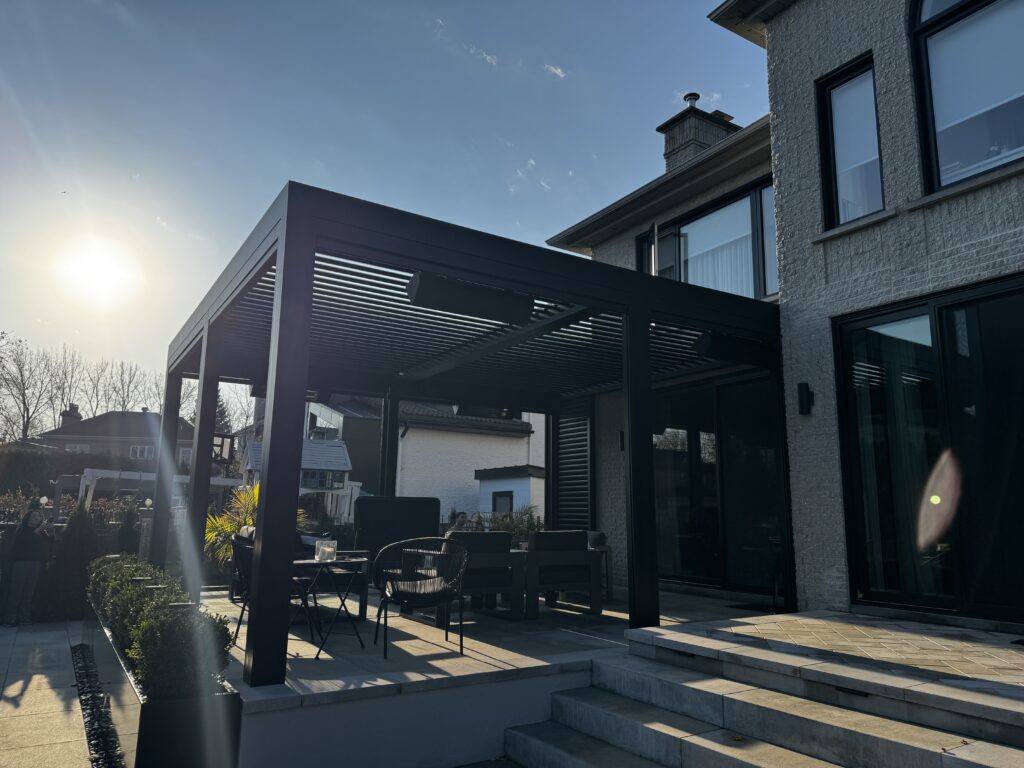

The Ultimate Guide to Aluminum Pergolas
An aluminum pergola is a modern outdoor architectural structure that uses lightweight, high-strength aluminum alloy as its primary frame. Its purpose is to provide shade, rain protection, and a defined living area in a backyard, patio, or garden, and it is widely popular for its extremely low maintenance, exceptional durability, and sleek, contemporary aesthetics.
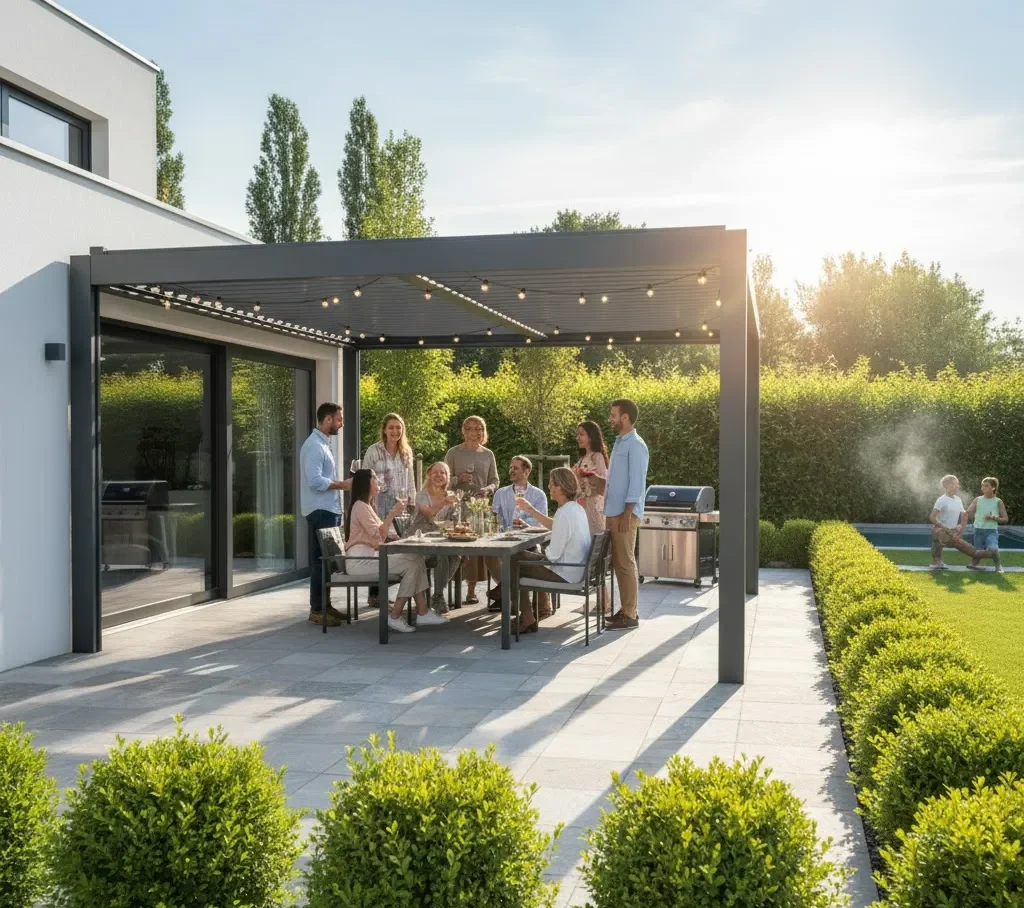
The dream of a perfect outdoor living space—a place to entertain, relax, and connect with nature—is universal. Yet, this dream is often compromised by the realities of harsh sun, sudden rain, or the constant upkeep of traditional materials. An aluminum pergola might just be the solution you’ve been searching for.
But before you invest, you undoubtedly have questions. Is it truly durable? What types are available? Is it better than a classic wood pergola? Do I need a permit? And critically, what does an aluminum pergola cost?
As industry experts, we’ve crafted this ultimate guide to answer your 10 most critical questions.
We will cover everything from material science to installation hurdles, empowering you to make a confident and informed decision.
1. What is a aluminum pergola?
At its most basic, an aluminum pergola is an outdoor pergola structure that uses extruded aluminum for its posts, beams, and roof system, distinguishing it from traditional wood, vinyl, or steel counterparts.
Factory Insight: The Material That Matters
However, not all aluminum is created equal. From our direct factory and manufacturing experience, premium aluminum pergolas almost exclusively use 6063-T5 grade aluminum alloy. This specific alloy is renowned in architectural applications for its superior strength-to-weight ratio, excellent finishing characteristics, and, most importantly, its outstanding resistance to corrosion. It’s the same class of material trusted in the construction of building facades and even in aerospace.

The second critical component is the finish. A high-quality aluminum pergola is not merely painted. It is protected by a high-performance powder coating. This is an advanced finishing process where a dry powder is electrostatically applied and then cured under heat, fusing it to the metal.
But what is powder coating made of? It’s a dry powder, not a liquid paint. The magic lies in how it’s applied. The aluminum parts are grounded, and the powder is given a positive electrostatic charge. This charge makes the powder cling to the metal surface like a magnet.
Expert Recommendation: Finish Quality Standards
We strongly recommend looking for finishes that meet AAMA (American Architectural Manufacturers Association) standards, specifically AAMA 2604 or the even more rigorous AAMA 2605. This coating is the structure’s primary defense. It provides the final color—be it matte black, charcoal gray, or a surprisingly realistic aluminum pergola with wood grain finish—and is engineered to resist fading, chalking, scratching, and chipping for decades, even in harsh coastal or high-UV environments.
What Are the Pros and Cons of an Aluminum Pergola? (Table-First)
Before you invest, it’s essential to objectively evaluate the benefits and drawbacks. As experts committed to transparency, we believe you should have all the facts. Here is a quick overview in a table, followed by a deep dive into each point.
| Pros | Cons |
|---|---|
| • Extreme durability (no rust) | • Higher upfront cost |
| • Near-zero maintenance | • Style limitations (not rough-hewn/rustic) |
| • Modern aesthetics & many finishes | • Heat absorption on dark colors → pick light tones |
| • Adjustable louvers; rain-proof when closed | / |
| • Non-combustible; pest-proof | / |
Deep Dive: The 5 Core Advantages of an Aluminum Pergola
Advantage 1: Extreme Durability & Weather Resistance
This is arguably the most significant benefit. Aluminum, by its nature, does not rust. When exposed to air, it instantly forms a hard, microscopic layer called aluminum oxide. This layer acts as a protective shield, preventing any further corrosion or degradation.

Contrast this with other materials:
- Wood: Is organic. It is susceptible to rot, decay, and moisture-induced warping. It is a food source for termites, carpenter bees, and woodpeckers.
- Steel: Will rust (corrode) when its protective coating is breached, leading to structural integrity issues.
- Vinyl (PVC): Can become brittle and crack in cold weather, and it can warp or sag under intense heat. It can also suffer from chalking and fading over time.
Expert Insight:
An AAMA-compliant powder-coated aluminum structure is built to last 20, 30, or even 50+ years with almost no loss of integrity.
Advantage 2: Near-Zero Maintenance (The “Time & Money” Saver)
The aluminum pergola benefits are most obvious here. The lifetime maintenance of a wood pergola is a significant, recurring burden. Wood requires pressure washing, sanding, and re-staining or re-painting every 2-3 years. This is a time-consuming weekend project or an expensive professional job, often costing $500-$1000 each time.
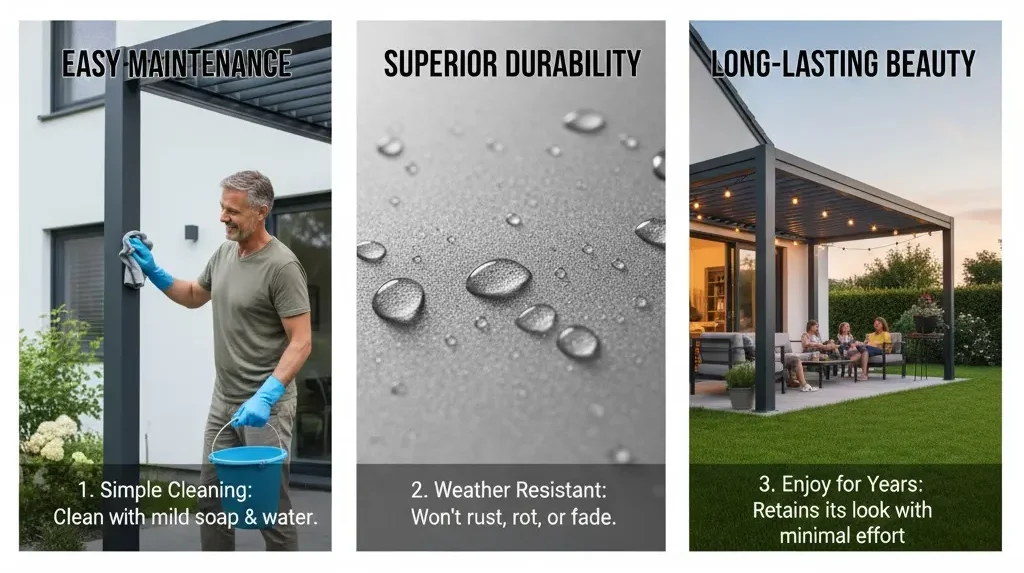
An aluminum pergola demands almost none of this. To keep it looking new, all it requires is an occasional rinse with a garden hose and, perhaps once a year, a wash with mild, non-abrasive soap and water. No sanding. No painting. No sealing. You will never have to worry about termites, rot, or splintering. This near-zero maintenance saves you thousands of dollars and countless hours over the structure’s lifespan.
Advantage 3: Modern Aesthetics & Design Flexibility
Aluminum can be extruded into incredibly precise, clean, and minimalist shapes that are simply not possible with wood. This makes it the perfect choice for modern, contemporary, mid-century, and transitional homes. Fasteners and gutter systems are often intelligently hidden within the beams and posts, creating a seamless, high-end look.
Furthermore, the color and finish options are vast. While matte black and charcoal gray are popular for a striking modern look, wood grain finishes (achieved through a sophisticated process called sublimation) are a game-changer. You can have the warm, inviting look of oak, cedar, or walnut while retaining all the low-maintenance benefits of aluminum.
Advantage 4: Superior Functionality (Adjustable Louvers)
While you can get a simple, traditional open-roof aluminum pergola, its true potential is realized in louvered models. These are not just covers; they are functional machines. A louvered roof allows you to precisely control your environment.
- Full Sun: Open the louvers to 135 degrees to let in maximum light and warmth.
- Partial Shade: Angle the louvers to block the harsh midday sun while maintaining airflow.
- Full Shade & Rain-Proof: Close the louvers completely. The interlocking blades form a watertight seal. A sophisticated, integrated gutter system (hidden inside the beams) channels rainwater away and down through the posts, keeping your furniture and your guests completely dry.
Advantage 5: Superior Safety & Resilience (Fire & Pests)
Aluminum is a non-combustible material. It will not ignite, burn, or contribute to the spread of a fire.
Expert Insight:
This is a critical, non-negotiable safety feature for any pergola for outdoor kitchen where it will be placed over a grill or open flame. It also provides invaluable peace of mind for homeowners in wildfire-prone regions.
Additionally, as mentioned, it is 100% pest-proof. Termites and carpenter bees have zero interest in it.
An Honest Look: The 3 Potential Cons of an Aluminum Pergola
Con 1: The Initial Investment Cost
Let’s be direct: a high-quality, motorized louvered aluminum pergola will have a higher initial pergola cost than a basic DIY wood or vinyl kit.
A Note on Trust & Value:
However, we urge customers to calculate the Total Cost of Ownership (TCO). When you factor in the 5-10 year lifespan of a typical wood pergola plus its recurring biennial maintenance costs, the aluminum pergola—with its 30+ year lifespan and zero maintenance costs—is almost always the more economical choice in the long run. It’s an invest once, enjoy for decades proposition.
Con 2: Style Limitations
While wood grain finishes are impressive, they are still a finish on a perfectly smooth, straight piece of metal. If your home’s aesthetic is aggressively rustic, farmhouse chic, or depends on the authentic, rough-hewn texture of real wood (complete with knots, cracks, and imperfections), an aluminum pergola might feel too “perfect” or “modern.”
Con 3: Surface Temperature (Heat Absorption)
This is a valid point based on simple physics. A dark-colored (especially black) aluminum pergola in direct, intense sunlight will get hot to the touch. This doesn’t affect its structural integrity, but it’s a consideration.
The solution is simple: choose a lighter color. A white, beige, or light gray powder-coated finish will reflect most solar radiation and remain surprisingly cool to the touch, even on the hottest days.
3. What is the Purpose of an Aluminum Pergola?
A modern aluminum pergola is far more than just pergola shade. It’s a versatile, multi-functional structure designed to solve specific problems and unlock new lifestyle possibilities—ultimately increasing your property’s value.
Core Function: All-Weather, Four-Season Protection
This structure transforms an unpredictable patio into a reliable four-season room.
Shade: Louvers provide dynamic, adjustable shade far superior to a fixed roof.
Rain Protection: A closed louvered roof with an integrated gutter system is 100% rain-proof. A sudden shower no longer means rushing to bring cushions inside.
Wind & Snow: Quality aluminum pergolas are engineered structures. They are wind-rated (often to 100+ mph) and have certified snow-load capacities.
Enhancing Outdoor Living Experiences (Specific Use-Cases)
This is where the pergola becomes the centerpiece of your backyard.
The Perfect Poolside Pergola
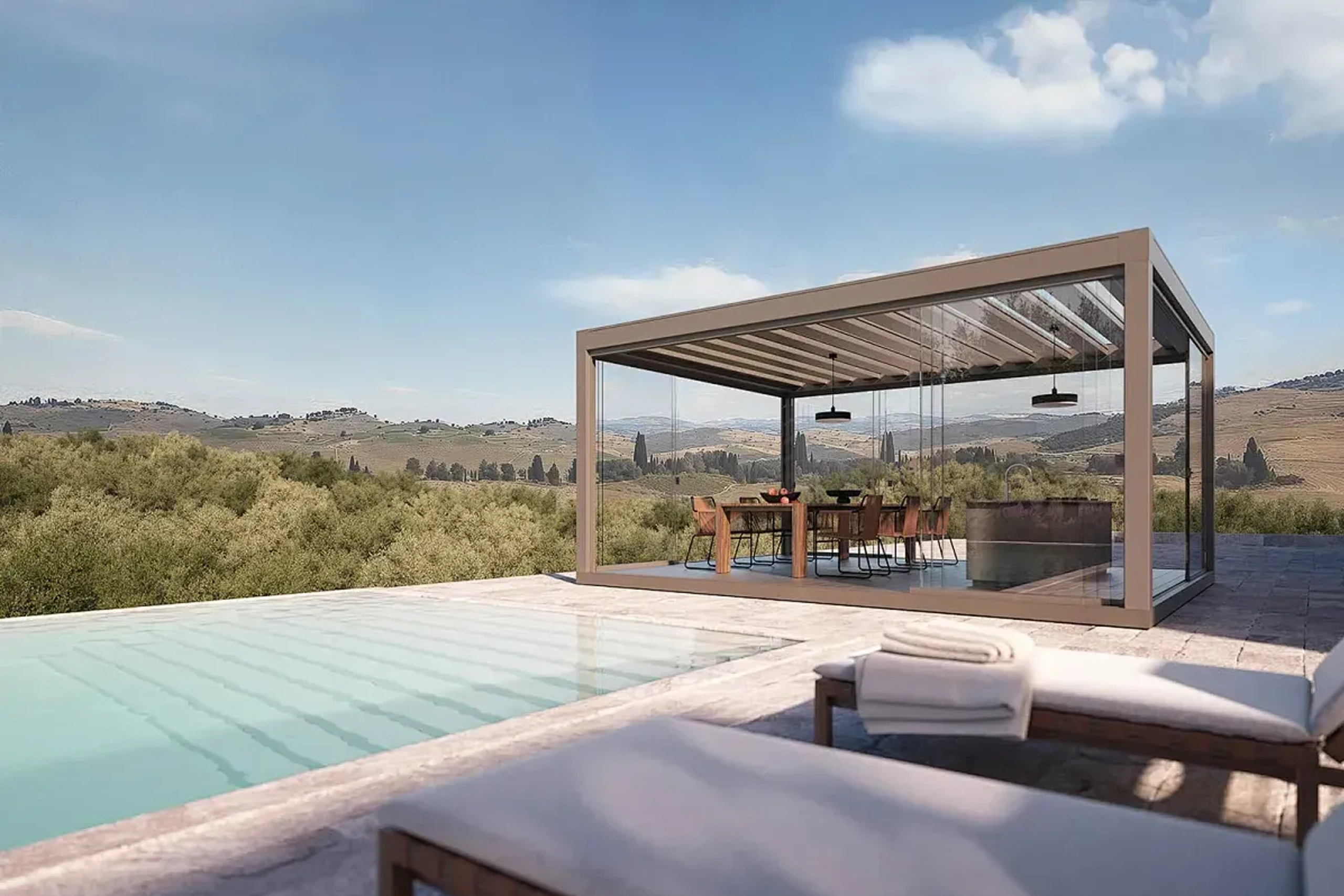
Aluminum is the ideal material for a poolside application. It is completely unfazed by splashes of chlorinated or saltwater. Unlike wood, it will never splinter, making it safe for bare feet. It’s the perfect way to add a resort-style poolside pergola idea to your home.
The Ideal Pergola for a Deck
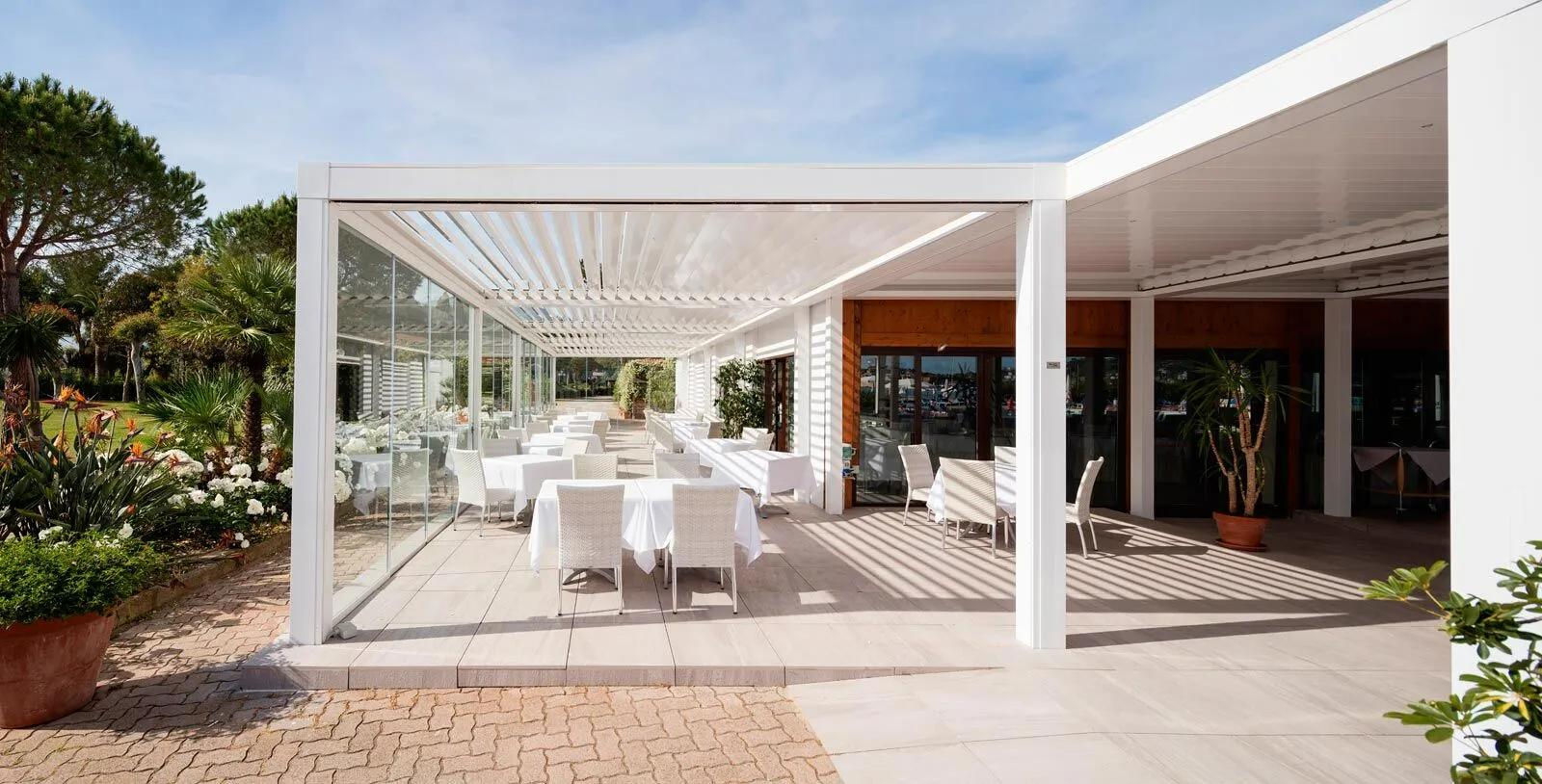
Want to add a cover to your existing wood or composite deck? An aluminum pergola’s key lightweight property is a massive advantage. It imposes significantly less structural load on your deck’s frame compared to a heavy, solid-wood timber structure.
The Ultimate Outdoor Kitchen Pergola
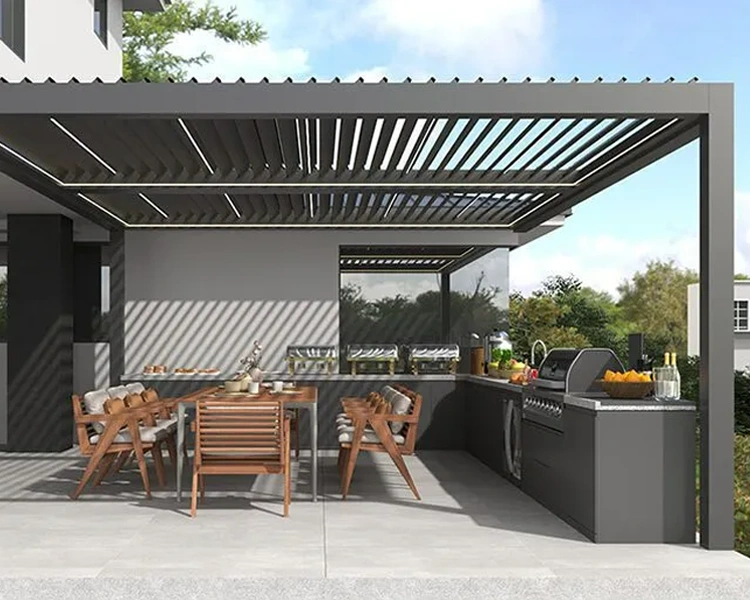
The non-combustible nature of aluminum makes it the safest choice for covering expensive grills, smokers, and side burners. The slick, non-porous powder-coated surface is also incredibly easy to clean, resisting grease stains and smoke buildup.
Boosting Your Property Value
A well-designed, professionally installed aluminum pergola is not an expense; it’s a capital improvement. It effectively adds finished, usable square footage to your home—a feature highly coveted in real estate.
Authoritative Insight:
“According to real estate market analyses, attractive and functional outdoor living spaces are one of the top 10 features that boost a home’s appeal and resale value.”
4. What Are the Main Types of Aluminum Pergolas?
The primary differentiator in modern aluminum pergolas is the roof operation. Understanding the difference between motorized, retractable, and manual is key to matching a product to your budget and lifestyle.
1. Motorized Adjustable Louvered Pergola
This is the most popular and iconic modern type. A quiet, hidden motor (operated by remote, wall switch, or a smartphone app) controls the tilt of the louvers, typically from 0 (open) to ~135 degrees (closed). This allows for precise control over sun and shade. When closed, the louvers interlock to create a rain-proof roof with built-in drainage.
2. Motorized Retractable Louvered Pergola
This is a more advanced, premium category. This roof system does both: the louvers can tilt for light control, and they can retract (stacking neatly to one side) to leave the roof completely open. This is the ultimate in flexibility, perfect for unobstructed stargazing or allowing maximum winter sun to enter your home’s windows.
3. Manual Adjustable Metal Roof Pergola
This is a more cost-effective option that still provides excellent functionality. Instead of a motor, the louvered roof is operated by a manual hand crank. You get the same tilting louver benefits (sun control and rain protection) but at a lower price point, sacrificing the convenience of automation. (Note: These are less common for retractable systems, which require more force).
5. How Do I Choose the Right Aluminum Pergola?
Choosing the right aluminum pergola comes down to answering three practical questions.
Step 1: Assess Your Core Needs
If you only need partial shade from the afternoon sun, a fixed pergola will suffice. But if your goal is to create a truly all-weather outdoor space that can withstand rain or shine, whether it’s windy or snowy, then a sturdy aluminum louver pergola system is essential.
Step 2: Measure Your Space – What’s a Good Pergola Size?
Before calculating the appropriate pergola size, you need to determine where you want to place your furniture. Then, using masking tape, mark the space for a six-person dining table or L-shaped sofa. Then, leave 2-3 feet (approximately 0.6-0.9 meters) of clearance around the perimeter to allow for easy movement.
However, after years of selling pergolas, we’ve found that 10×12-inch or 12×16-inch aluminum pergolas are the most popular choices, typically for families with 4-6 people.
Note: If attaching to your house, the pergola height should be proportionate, often aligning with the bottom of the eaves or the top of a door frame.
Step 3: Choose Installation: Freestanding vs. Wall-Mounted
Freestanding: A standalone structure with four or more posts. This is a destination piece, perfect for a poolside, a garden, or the center of a large patio.
Wall-Mounted (Attached): This style attaches directly to your home’s exterior wall on one side, supported by two posts on the other. It’s ideal for creating a seamless extension of your indoor living space and is a very common choice for pergola for deck or patio covers.
6. Installation, Permits, and Cost
Do I Need a Permit for an Aluminum Pergola?
Yes, permits are required for installing awnings in most areas.
While a small, lightweight, non-permanent DIY kit might fly under the radar, any substantial, permanent aluminum pergola—especially one that is attached to the house or has a foundation—will almost certainly require a pergola permit.
Why? Local building codes regulate structures based on size, height, proximity to property lines, and structural loads (like wind and snow). Furthermore, if you live in a community with an HOA (Homeowners Association), you will absolutely need their design approval before you apply for a permit. Always check with your local building department first.
How Much Does an Aluminum Pergola Cost?
The aluminum pergola price can range dramatically, from $2,700 for a basic, manual, 10×10 DIY kit to over $30,000 for a large, custom-sized, motorized, and professionally installed system with all the accessories.
The main factors driving the cost of pergola are:
- Size: The single biggest factor.
- Type: Manual is cheaper than motorized. A tilting-only louvered roof is cheaper than a fully retractable one.
- Brand & Material: Premium brands use thicker-gauge aluminum and higher-end motors and electronics.
- Automation: Adding accessories like rain/wind sensors (that close the roof automatically), integrated LED lighting, or built-in heaters will increase the price.
- Installation: Professional installation is a significant but worthwhile part of the cost, ensuring it’s safe, level, and waterproof.
“For a detailed cost breakdown, see our [Pergola Cost Guide].”
7. Aluminum Pergola vs. Other Outdoor Structures
Your outdoor shade options are plentiful. The louvered aluminum pergola offers unique flexibility, but how does it really stack up against a traditional gazebo or a simple awning? This pergola vs gazebo question is a common one.
Aluminum Pergola vs. Gazebo vs. Awning (The Ultimate Comparison)
| Feature | Aluminum Pergola | Gazebo | Awning |
|---|---|---|---|
| Shade Control | Adjustable louvers | Fixed roof only | Retractable fabric |
| Weather Use | Sun & rain protection | Always covered | Must retract in wind/rain |
| Durability | 20+ years, no rust | 10–15 yrs, wood may rot | 5–10 yrs, fabric replacement |
| Flexibility | High – open & close | Low – permanent shade | Medium – open or closed only |
| Maintenance | Very low | Medium | High |
| Cost Value | High ROI | Medium | Low upfront, high long-term |
8. Conclusion: Why an Aluminum Pergola is a Smart Long-Term Investment
An aluminum pergola is more than just a backyard accessory; it is a profound, long-term investment in your home’s value and, more importantly, in your lifestyle.
It represents the perfect synthesis of four core values:
Extreme Low-Maintenance
(Saving you time and money for decades).
Extreme Durability
(A one-and-done investment that will outlast most other structures).
Modern Aesthetics
(Instantly updating your home’s exterior appeal).
Ultimate Functionality
(Giving you true all-weather control over your environment).
Extremely high investment value
(significantly increase the value of your property by 5-20%)
While the initial pergola cost may be higher than that of a basic wood kit, its exceptional lifespan, zero-maintenance requirements, and superior performance make the aluminum pergola the most intelligent, cost-effective, and enjoyable long-term investment you can make in your outdoor living space.
Frequently Asked Questions About Pergolas
1: Does a pergola need a foundation?
Yes, for safety and longevity, almost all permanent pergolas require some form of foundation, typically concrete footings, especially aluminum ones designed to withstand wind and snow.
2: Is a pergola considered a permanent structure? Will I need a permit?
Generally, yes, a well-built pergola anchored to the ground is considered a permanent structure. Whether you need a permit depends on its size and your local building codes. It’s always best to check with your local planning department.
3: Are pergolas completely waterproof or do they block all sun?
Traditional pergolas with open roofs offer only partial shade. However, modern bioclimatic pergolas with adjustable louvered roofs can be closed to become fully waterproof and can be adjusted to block as much or as little sun as you like.
4: What’s the main difference between a pergola and a gazebo again?
The biggest difference is usually the roof. Gazebos typically have a fixed, solid roof providing full shade. Pergolas traditionally had open-slatted roofs, but modern ones often feature adjustable louvered roofs for flexible control over sun and rain.
5: What’s a rough starting price range for a pergola?
Prices vary hugely based on material, size, and features. A basic wood kit might start around $2,000-$5,000, while a high-quality, motorized aluminum pergola system typically starts from $8,000-$15,000 and goes up.